



The start of the second semester is accompanied by the eternal debate on the impact of social inclusion policies through the establishment of quotas for disadvantaged classes as a criterion for admission to federal universities. This debate has become more heated due to the recent decision by the US Supreme Court, which ruled to end the quota program in the United States for admission to universities, in effect since 2003, on the grounds that the US Constitution guarantees equal protection to citizens. The Supreme Court's majority decision reflected an existing division in American society.
In Brazil this week, the House of Representatives approved the renewal of the quota law, with a new review scheduled for 2033.
Studies show that the average performance of students benefiting from affirmative action programs is lower than that of other students who are not quota holders. This should come as no surprise. If it were so easy for quota holders to outperform non-quota holders, no one would be discussing the existence of quotas. It is precisely because they are worse that the idea of affirmative action arises. Nor is it the case that these results should be taken as irrefutable proof that quotas should be rejected outright, as they would only serve to undermine the meritocracy of university entrance exams.
All the difficulties surrounding quotas stem from the fact that universities play a dual role. They have become the main factor in social advancement in the modern world and, in addition, have the mission of training the professionals who will be available to society in the near future. While the first criterion easily admits a more socially just approach, the second would naturally recommend a stronger commitment to academic excellence. The challenge is to find a way to reconcile the two principles. The answer certainly does not lie in increasing the number of places reserved exclusively for affirmative action minorities, currently at 50%. Excessive numbers widen the gap between quota and non-quota students, inflating the price of inclusion.
For those who believe that merit should always prevail, the question remains: what is merit?
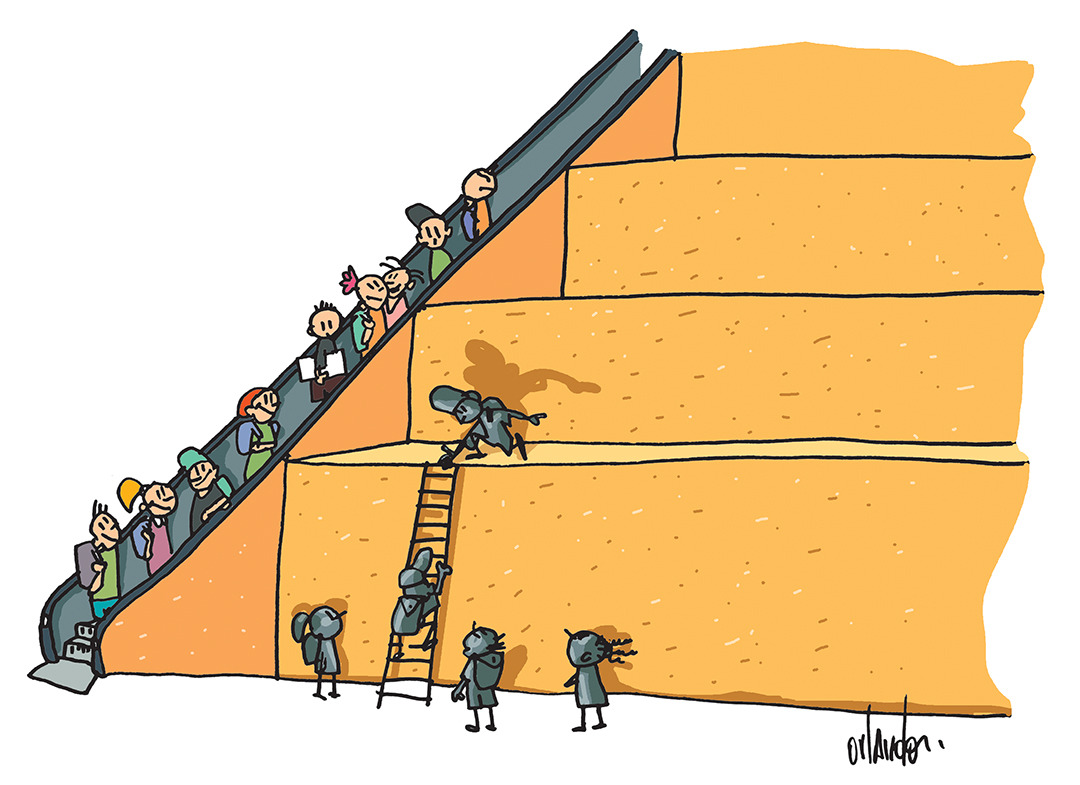
Eduardo Giannetti points out that inequality poses an ethical problem depending on how it was established. For him, “the crucial question is: does the inequality observed essentially reflect the different talents, efforts, and values of individuals or, on the contrary, is it the result of a rigged game at its origin—a profound lack of equity in initial living conditions, deprivation of basic rights, and/or racial, sexual, or religious discrimination?”
American philosopher John Rawls goes further. For him, natural abilities are no "fairer" than the birthrights that the nobility attributed to themselves or the advantages of growing up in a wealthy family. For the philosopher, attributes such as strength, intelligence, and beauty are an undue reward, since they result from random combinations of genes, not individual virtues. Therefore, according to Rawls, if it is unfair to discriminate against someone because of their skin color, it is unfair to favor someone else because they were lucky enough to be born with the right qualities at the right time.
Thus, the very idea of merit seems untenable if we assume a more absolute notion of justice, as Rawls does. Pragmatically, I understand that it is natural to hire someone based on their academic performance. The problem is that it becomes more difficult to equate the notion of meritocracy with that of justice.
The solution lies in improving the standard of elementary education.
One of the characteristics of academic knowledge is that students only progress well when they have mastered the previous stages. Certain subjects, such as mathematics, are simply impossible to advance in without knowing the classic operations. Not surprisingly, it has recently been found that mathematics education in Brazil has been deteriorating year after year. Thus, wanting the entrance exam to be the only selection criterion for university admission is like putting jiu-jitsu fighters in the ring, one with a white belt and the other with a black belt, and expecting the result to be anything other than a crushing victory for the black belt.
Therefore, the right place to combat the knowledge gap is in the early years of elementary school. Educational policy should prioritize free basic education during the period of cognitive development and charge tuition fees at universities, even public ones, as a measure of social justice.
We know that the state cannot guarantee free education for everyone throughout their academic career. At the same time, if there is equity in basic education, it becomes more palatable to reconcile work and study, and with that, even the less fortunate would be able to pay for higher education tuition. Prioritizing budget funds to subsidize free public universities, to the detriment of better basic education, is a policy that I cannot understand.
With greater inclusion and quality basic education, the learning gap between college entrance exam candidates would be smaller and, consequently, the chances of reducing the number of social inclusion quotas in universities would be greater.
More about
Education


