



“The punishment which the wise suffer who refuse to take part in the government, is to live under the government of worse men.” Plato
Brazil possesses a propensity for self-flagellation, periodically engaging in self-destruction. Whenever signs of improvement emerge, an event invariably occurs to destabilize its structures and dismantle its institutions, leading to irreparable losses in its economy, credibility, legal certainty, and social stability. It resembles a phoenix that, after living for 300 years, allows itself to burn in a pyre, only to subsequently rise from its own ashes. In Brazil's case, this cycle spans 10 years, and each time it is reborn, a piece of it is invariably missing.
This phenomenon stems from a dearth of political leadership capable of unifying the nation, fostering economic growth, ameliorating the social conditions of its populace, and elevating its standing in the global arena.
Historically, Brazilian politics has been tumultuous, characterized by weak leadership. The fall of the Empire was succeeded by the Old Republic, which, from a contemporary perspective, appears as a rudimentary sketch of a republican experiment where the populace, including women, had no participation, and power alternated between the 'coffee' and 'milk' factions, referring to the purported elites of São Paulo and Minas Gerais.
During the 1930 coup d'état, Getúlio assumed power and commenced his reign. He was inaugurated with the prestige of Tenentism and the support of the Integralists, until the Estado Novo (New State) was established in 1937. This regime produced Brazil's first and only dictator truly worthy (or unworthy) of that title.
Subsequently, Getúlio's downfall occurred, followed by a turbulent period of democracy culminating in Jango's parliamentary system in '61. From that point onward, events included Jango's overthrow, the 1964 military regime, re-democratization, the New Republic, and all subsequent developments: Collor's impeachment, the Plano Real, Lula's two terms, the Mensalão scandal, Dilma's presidency, her impeachment, Operation Lava Jato, the criminalization of politics, Bolsonaro's administration, heightened polarization, hate speech, widespread disillusionment with institutions and individuals, and ultimately, January 8, 2023.
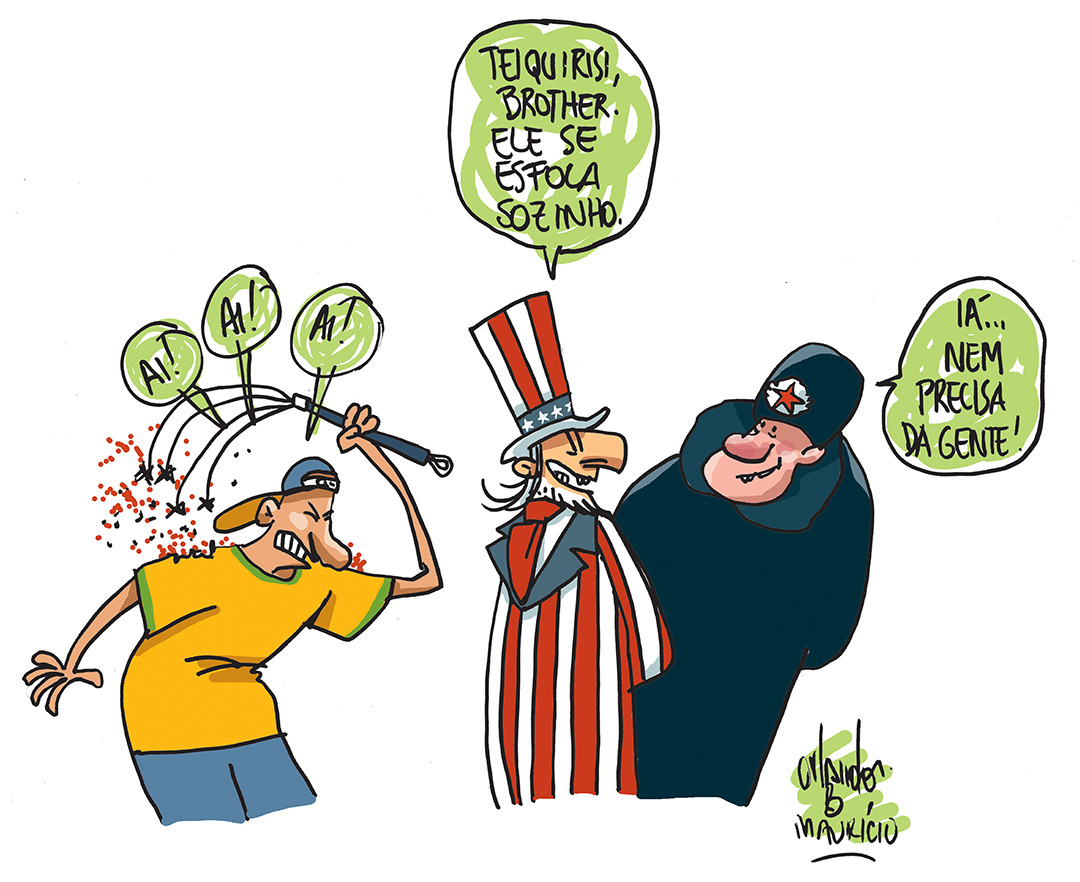
I attribute this persistent self-inflicted mortification to the scarcity of competent political leaders genuinely committed to the nation. Lula represents an exception, not necessarily due to monumental achievements, but his merits are linked to his respect for democracy and years of exclusive dedication to politics, often losing more elections than he won, thereby acquiring the acumen to navigate the current turmoil. Presently, any ignoble and unprepared individual seeks elective office, eyeing the enormous funds associated with the position.
Our system does not incentivize the gradual development of politicians to accrue experience and cultivate leadership for higher aspirations. Established and representative parties are deficient in possessing a well-defined succession program. Illustrative examples include the absence of a successor for Lula within the Workers' Party (PT) and the decline of the Brazilian Social Democracy Party (PSDB).
The paramount issue is that the scarcity of competent political leadership does not merely confine its repercussions to calamitous administrations. We are witnessing that this political acephaly serves as fertile ground for new coups and forceful power seizures. Operation Lava Jato attempted a coup through the instrumentalization of the judiciary. By a twist of fate, a hacker dismantled this stratagem, but only after inflicting tens of billions of reais in damages to the country, rendering thousands unemployed, and devastating leading Brazilian business sectors, thereby precipitating another national decline. With the recent Federal Police operation, we have observed that January 8th was meticulously planned to seize power with the involvement of active-duty military personnel and to arrest Supreme Federal Court justices. It nearly succeeded, but this failed coup d'état does not signify the demise of the underlying ideology.
To disrupt this cycle of self-flagellation, the nation requires leadership committed to institutional stability, sustainable development, and social justice. This necessitates not only emergency measures to address immediate crises but also profound structural reforms to foster inclusion, equal opportunities, and state efficiency. Furthermore, it is imperative to strengthen democratic institutions and promote civic participation and social dialogue. Only through a serious and enduring commitment to these values and principles can the country overcome its cycles of self-flagellation and construct a more prosperous, just, and peaceful future for all its citizens.
For now, with Operation Lava Jato and the attempted coup of January 8th, Brazil has once again tightened the hair shirt that lacerates its flesh and tears its very core.
More about
Politics


