



Note to the reader - This trilogy develops an argument across three complementary movements. The first article posits that politics is inevitably a hardball game, and a moralistic refusal of this logic merely transfers power to those who better comprehend institutional incentives. The second demonstrates that acknowledging political realism does not entail accepting the unlimited exploitation of constitutional rules, lest democratic erosion occur. The third shifts focus to the international arena, illustrating that countries under permanent institutional tension diminish their external strategic capacity. The three texts are not contradictory: they form a logical sequence encompassing realism, limits, and projection.
Brazilian politics has been analyzed, with excessive frequency, through a moralizing framework that oversimplifies profoundly complex processes. Institutional crises are commonly attributed to individual ethical deviations, power struggles are depicted as pathologies, and distributive conflicts appear as mere failures of the democratic system. This approach, while rhetorically appealing, proves analytically deficient. It disregards an elementary tenet of political science: politics is, fundamentally, an imperfect mechanism for conflict resolution through the exercise of power.
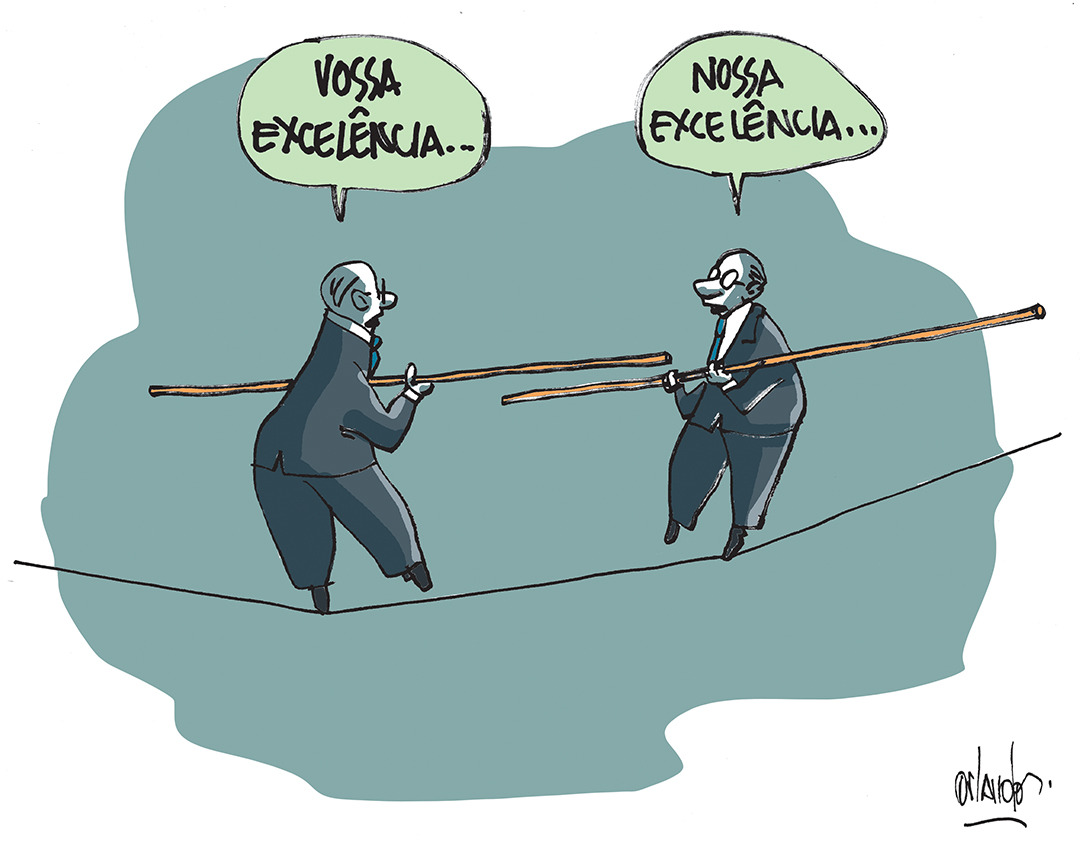
Since Niccolò Machiavelli laid the foundations of modern political thought in The Prince, the realist tradition has recognized that governance involves making choices under conditions of scarcity, conflict, and uncertainty. Political virtù does not consist of moral purity, but rather in the capacity to preserve order and produce effective decisions in adverse contexts. Similarly, Max Weber, in distinguishing the ethics of conviction from the ethics of responsibility, warns that noble intentions do not absolve the political agent of the foreseeable consequences of their actions. Politics that refuses to operate within this framework abdicates its organizing function and transfers conflict to other arenas, often less transparent and more unstable.
This interpretive framework is compatible with the notion of hardball politics, systematized by Christopher John Matthews. The concept does not describe an immoral politics, but rather a realistic one, in which rational actors utilize available instruments—such as agenda control, cost imposition, and asymmetric negotiation—to maximize outcomes. Denying this logic does not eliminate it; it merely confers strategic advantage to those who comprehend it better. In the Brazilian context, the refusal to accept politics as a strategic game has produced three interconnected phenomena: the weakening of the Executive branch, the intensification of judicialization, and a distinct asymmetry between ideological camps.
Coalition Presidentialism and the Mastery of Timing
Brazilian coalition presidentialism, characterized by Scott Mainwaring as a system marked by high party fragmentation and multiple veto points, necessitates constant coordination between the Executive and Legislative branches. Electoral legitimacy alone is insufficient for effective governance; presidents fail not merely due to isolated errors, but primarily due to chronic political isolation. Administrations that conflate moral authority with command capacity rapidly lose control of the agenda and transition into a defensive operational mode. The conviction that governance is possible without conflict — or "above politics" — betrays a perilous misunderstanding of institutional design.
By abdicating the legitimate use of instruments of power and negotiation, the Executive branch haphazardly transfers influence to the National Congress. When this transfer occurs without proper coordination, the outcome is not stability, but rather a decisional paralysis that immobilizes the nation. The Congress, in turn, profoundly comprehends the dynamics of hardball politics. Legislative power resides in the refined control of the process: committees, rapporteurships, filibustering, and, critically, the mastery of timing. Deputies and senators operate according to an incremental rationality, mastering political timing in a manner that the Executive often struggles to match.
As Douglass North observes, institutions reduce uncertainty by creating predictable incentives; however, where such predictability falters, actors seek alternative routes to achieve their objectives. The Brazilian Legislative branch has internalized this logic. The public demonization of this institutional practice does not neutralize it; on the contrary, it weakens the Executive and legitimizes the informal transfer of power to parliamentary leaders who are not held to the same standard of accountability before the electorate. Governments that refuse to negotiate strategically do not eliminate bargaining; they merely forfeit control over its terms.
Ideological Asymmetries and the Balance Between Ethics and Power.
Upon analyzing the ideological landscape, the Brazilian left has demonstrated a superior capacity for adapting to a realist logic. Firstly, it constructed narrative hegemony by associating its agendas with universalist values, thereby influencing the lexicon of public debate — an element Robert Dahl identifies as essential in pluralist competition. Secondly, it maintained continuous institutional presence across various spheres of the state and civil society. Thirdly, it practiced selective pragmatism in power, understanding that governance necessitates accepting reputational costs to preserve decisional capacity.
The same cannot be asserted regarding the Brazilian right. Its fragmentation stems from primary strategic failures: the difficulty in accepting political compromise, the excessive personalization of leadership, and the absence of robust political parties. According to Robert Dahl, democracies rely on elites who accept temporary losses in exchange for permanent institutional gains. The right, by substituting strategy with moral indignation, mobilizes masses but fails in its attempts to govern, as indignation generates momentary energy, whereas governability demands architectural planning and patience.
Within this political landscape, the so-called "Centrão" emerges as a rational response to institutional design: a governability technology that stabilizes majorities and reduces decision-making uncertainty. While demonizing this bloc may yield immediate electoral gains, it does not eliminate it from the process; on the contrary, it merely hinders its comprehension and potential reform. Governments that attempted to disregard this reality ultimately governed against the system, resulting in institutional paralysis and an accelerated erosion of their own authority.
The overall outcome is a Brazilian political landscape characterized by asymmetrically distributed "hardball politics." While some actors comprehend the logic of power and operate within it, others attempt to supplant it with a moralization that merely shifts power to non-electoral arenas and weakens democratic accountability. Politics is not a contest of static virtues, but a struggle for direction and outcomes. Understanding it as hardball politics does not imply abandoning ethical values, but rather defending them effectively within institutions.
Ultimately, ethics without power is impotence, and power without limits is arbitrary rule. Democratic maturity lies precisely in the balance between both. Denying the game does not make it fairer; it merely ensures that adversaries, who understand it better, will play it with far greater success.
More about
Politics


