



On Friday, August 28, 2026, free campaign airtime returned to Brazilian radio and television and will remain on the air until October 1. It is the same system created for a country that did not have the internet, distributed based on a logic that has never been one of equality and sustained by a tax waiver that, in 2026 alone, amounts to nearly R$ 996 million. This tax break works as follows: political parties and candidates pay nothing to radio and TV stations, but the law requires these companies to allocate part of their programming schedule to political advertising. In return, the government allows them to deduct from their income tax the amount corresponding to the allocated airtime, as if that airtime had been sold normally on the advertising market. In practice, what costs the candidate nothing is paid for by taxpayers as a whole, in the form of tax revenue that is foregone. Television still matters, albeit to a decreasing extent. The real question is this: does this mechanism, as it is currently designed, still fulfill the purpose for which it was created?
The arithmetic of power disguised as equality
Free election airtime was created in response to a real problem: without it, only those who could afford to buy advertising space would appear on television. Today, the law allocates 90% of the airtime proportionally based on the size of each party’s or coalition’s delegation in the Chamber of Deputies and reserves only 10% for equal distribution among eligible parties. In practice, for the 2026 elections, this means that Luiz Inácio Lula da Silva’s coalition—comprising 127 federal deputies from the PT, PCdoB, PV, PDT, PSB, and the PSOL/Rede Federation—has 5 minutes and 31 seconds per day. Flávio Bolsonaro, with the PL’s 98 deputies, has 4 minutes and 20 seconds. Ronaldo Caiado of the PSD has 2 minutes and 2 seconds. Augusto Cury of Avante has 35 seconds. Romeu Zema and Renan Santos, who did not meet the performance requirement, have no block time at all.
Election programming, created to ensure equal access to information, now translates the power already consolidated in Congress into airtime. As Robert Dahl defined it when discussing pluralist competition, the health of a democracy depends on the ability of multiple voices to compete for space in shaping public opinion under minimally equivalent conditions. The current structure of campaign airtime does the opposite. It transforms existing political asymmetry into asymmetry in media exposure, shielded by legislation that treats this reproduction of power as a technical and neutral criterion.
The audience that avoids prime time
While this structure has remained virtually unchanged since its inception, the audience it was intended to reach has shifted. Surveys by the Brazilian Institute of Social Research show that the percentage of voters who watch the entire campaign broadcast has fallen from 35% in 2004 to 17% in more recent surveys. Datafolha had already reported that 45% of voters had no interest whatsoever in watching the program and that 38% believed it would have no influence whatsoever on their voting decision.
This shift is generational and measurable. Data from Cetic.br for 2026 show that digital platforms have already surpassed radio and television as the primary means of accessing information among Brazilians aged 16 and older: 72% of internet users access news daily through social media, compared to 58% who turn to radio and TV. The age breakdown highlights the problem even more clearly. While 74.1% of Brazilians over 55 typically get their news from television, only 49.3% of young people between the ages of 18 and 24 do the same. It is precisely the youngest voters—those who are still forming their partisan identities and who most need a diversity of information—who are structurally out of reach of campaign broadcasts.
Television has lost its monopoly on shaping political opinion and retains only a fraction of its former relevance. The Reuters Institute’s Digital News Report still shows TV technically tied with social media as a source of information, at around 50% each. For candidates without their own media resources, free campaign airtime remains the only channel with nationwide reach guaranteed by law. Abandoning this tool entirely would mean returning the entire field to the inequality of resources that it was created to curb.
Theater Without a Script
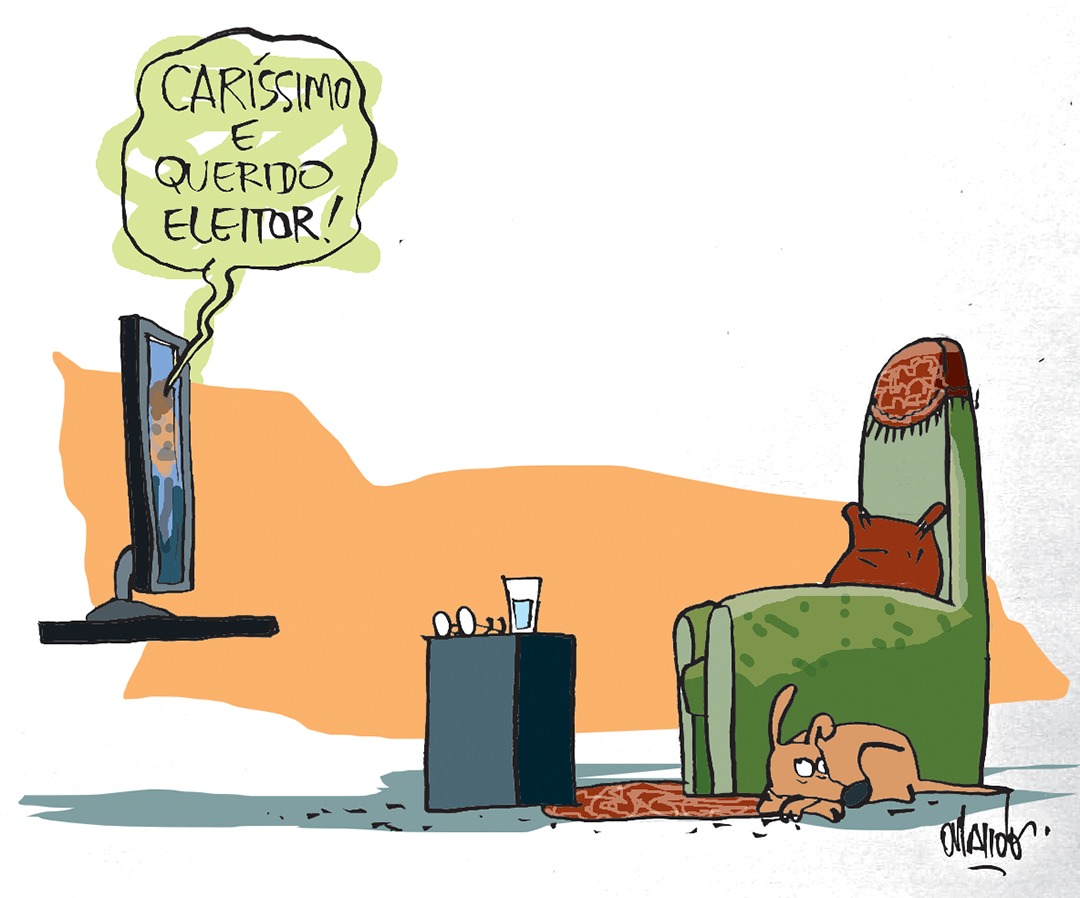
The problem, therefore, is not just a matter of time allocation. It lies in how that time is used. With no requirements regarding content, campaign airtime has become a showcase for theatrics. Jingles, skits, and mutual attacks take up the space that should be dedicated to presenting government initiatives. The current election lays bare this exhaustion: candidates vie for precious minutes of national airtime by trading accusations with one another and rarely go into detail about what they intend to do, with what resources, and by when.
As Steven Levitsky and Daniel Ziblatt observe when analyzing the silent erosion of contemporary democracies, institutions can preserve their legal form for decades while progressively undermining the function that justified their existence. Free campaign airtime illustrates this phenomenon precisely. The legal framework remains in place, public funding continues to be guaranteed, but the content that should be disseminated through this channel—reliable information about concrete government proposals—has been replaced by spectacle.
One possible solution: turning the schedule into a public commitment
Simply diagnosing the problem of obsolescence is not enough unless it is accompanied by a plan of action. The solution does not require abolishing free campaign airtime or accepting its gradual erosion. It requires changing the rules of the game within that framework. A new institutional design should follow certain criteria.
Each candidate should first file a detailed government plan with the Superior Electoral Court, including specific goals, an implementation timeline, and the source of the funds needed for each proposal. Generic proposals, such as “I will improve healthcare” or “I will create jobs,” could not be accepted without specifying how and with what budget they would be carried out. Television and radio airtime could only be used after this filing, and exclusively to elaborate on the content already submitted. Attacks on other candidates, references to opponents’ personal conduct, or any material not directly linked to the filed plan would be prohibited, under penalty of forfeiting the right to use that airtime on that day.
This model shifts the logic of campaign advertising time. It ceases to be a stage open to free use, subject to each campaign’s advertising instincts, and instead functions as a forum for early accountability. Criticism of opponents would remain entirely possible, but it would shift to where it belongs: the public debate, the press, and the comparison of the official government platforms themselves—not to a self-promotional monologue financed by the state.
The Difference Between Broadcast Rights and a Performance License
Ensuring access to television for those who cannot afford it remains a legitimate function of the state in an unequal democracy such as Brazil’s. The mistake lies in treating free electoral airtime as a blank check handed to each campaign, without any requirements regarding how it is used.
A substantive campaign broadcast, grounded in detailed and publicly filed government platforms, would serve two purposes at once. It would restore substance to a space currently occupied by theatrics and, for the first time, create a formal, verifiable record of campaign promises—one that could be used to hold candidates accountable after the election. Television may no longer be the center of gravity in Brazilian politics that it once was. But the public airtime that the government still funds for it need not continue to be wasted on theatrics. What it does need, however, is a script.
More about
Politics


The Power of Those Who Lose

The Debate Nobody Wanted
Supreme Court Without a Chief Justice


