


What kind of election begins with a foreign president calling the Brazilian president a “thief,” “convict,” and “socialist scum” on Brazilian soil? The question sums up the shift in the 2026 electoral debate: the race is already marked by external pressures, personal attacks, and institutional conflicts.
The first round of the 2026 general election is scheduled for October 4. Of the five pre-candidates guaranteed a spot in the televised debates—Lula, Flávio Bolsonaro, Ronaldo Caiado, Romeu Zema, and Augusto Cury—none has yet submitted a detailed campaign platform. The legal deadline for this submission is closer to the election, so the absence of such a platform, in and of itself, is normal. What is unusual, however, is the content of the pre-campaign. Public safety, utility rates, and institutional clashes dominate the news, while the debate over tax reform or the social security model receives only limited coverage compared to the extensive coverage of the diplomatic dispute between Brasília and Washington.
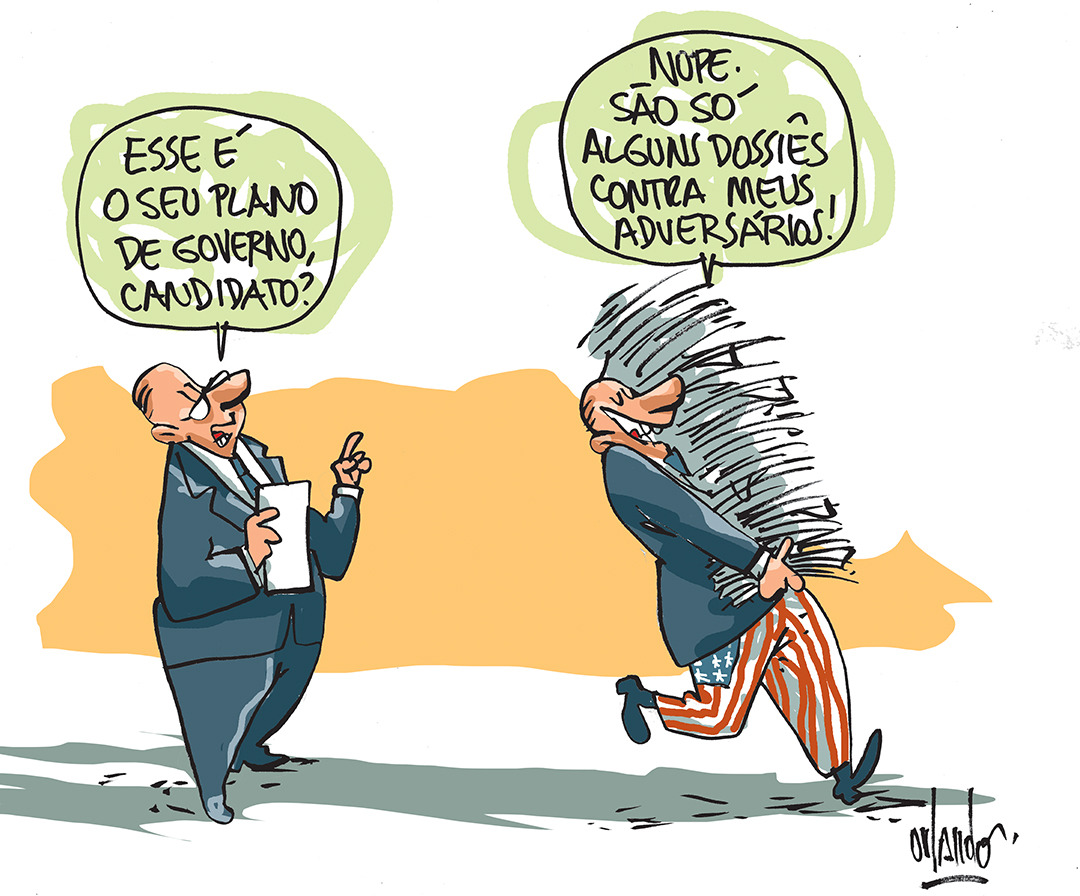
There are two reasons for this shift. The first is the scale of the race. The election remains fiercely contested, even with the recent setbacks suffered by Flávio Bolsonaro following the PL convention, and tight campaigns tend to focus their energy on crisis management rather than on developing a platform. The second reason is newer and more revealing. A series of practices that previously served as subterfuges—veiled and denied when questioned—are now carried out openly.
This shift in focus has a name in international relations theory. American political scientist Joseph Nye described soft power as the ability to achieve results through attraction and persuasion, in contrast to hard power, which is exercised through economic and military coercion. The 2026 Brazilian election is increasingly being shaped by the latter. Tariffs, denied visas, judicial reports, and messages of support from foreign leaders are taking the place that, in previous election cycles, belonged to more discreet diplomatic channels.
It’s worth making a distinction before moving on. The ideological alignment among right-wing leaders in different countries—the wave that brought Milei to the PL convention and earned Flávio Bolsonaro messages of support from Netanyahu—is a recurring phenomenon throughout history. The world oscillates between cycles that lean more to the left and those that lean more to the right, and like-minded leaders have always rooted for one another. This declared sympathy, in and of itself, is hardly extraordinary. What changes the game is another, more concrete layer: the use of state instruments—tariffs, visas, and reports—to directly influence the outcome of an election in another country. A head of government endorsing a foreign candidate is a long-standing practice. A foreign government publicly linking the maintenance of an economic sanction to the outcome of a legal proceeding involving that candidate’s father is an entirely different matter.
Foreign interference in elections has a long history. Russia was suspected of meddling in the 2016 U.S. election, but the Kremlin denied any involvement, and the debate dragged on for years amid accusations and denials. The defining feature of 2026 is different. Identified officials are making statements without mincing words, live on air, using their full names—something rare in previous decades.
No-Code Support
On May 26, Senator Flávio Bolsonaro was received by Donald Trump in the Oval Office at the White House. Sitting presidents typically reserve this type of formal reception for heads of state or high-ranking diplomats. Receiving a presidential candidate from another country before any election results are in breaks with protocol and signals direct support for the candidate. The gesture came weeks after Lula visited Trump and asked the U.S. government not to interfere in the Brazilian election.
On July 28, the Trump administration extended the national emergency declared regarding Brazil for another year, maintaining the 50% tariff on Brazilian imports. The official White House statement asserted that members of the Brazilian government are politically persecuting a former president, his family, and his supporters, and that this persecution contributes to the erosion of the rule of law in Brazil. The official justification replaces the original trade-based argument—which focused on unfair practices—with an explicitly political argument.
Senator Flávio Bolsonaro and former Congressman Eduardo Bolsonaro, who has left office, maintain direct contact with representatives of the American far right to ramp up this pressure. The Minister of Development, Industry, Trade, and Services, Márcio Elias Rosa, told Folha de S.Paulo that Flávio undermined trade negotiations by endorsing, during conversations at the White House, the very arguments used by the United States to justify the tariff.
The international stage
On Saturday, July 25, the PL convention that officially endorsed Flávio Bolsonaro’s candidacy—held at Pacaembu Stadium in São Paulo—garnered support from two influential foreign leaders. Argentine President Javier Milei attended in person and publicly attacked the Lula administration, a move that fits into the wave of ideological affinity already mentioned. He did not, however, limit himself to supporting a candidate: he called Lula a “thief,” “convict,” and “socialist trash,” and Minister Alexandre de Moraes “bald trash.” In a subsequent interview, he again called Lula a “thief” and “corrupt.” Israeli Prime Minister Benjamin Netanyahu sent a message of support for the candidacy, in the same vein.
Milei’s presence sparked an immediate reaction within the Brazilian right-wing camp itself. On Sunday, July 26, Governor Ronaldo Caiado described the event as a “shenanigan” and questioned the practical impact of the Argentine’s insults. On Monday, July 27, during an event in the city of Bebedouro, in the interior of São Paulo, Caiado was more direct and called the interference of foreign leaders in the Brazilian electoral process “unacceptable.” The dispute is no longer limited to the government versus the opposition; it also cuts across the internal ranks of the right. The Brazilian Foreign Ministry summoned the Argentine ambassador and recalled the Brazilian ambassador in Buenos Aires for consultations—a sign that the episode has gone beyond campaign rhetoric and led to formal diplomatic repercussions.
Doubt as a Strategy
Two U.S. State Department officials, Riley Bernes and Samuel Samson, requested to visit Brazil under the official pretext of discussing freedom of expression. The U.S. newspaper *The Washington Post* revealed that the real purpose of the trip was to meet with critics of the Brazilian electoral system and question the reliability of electronic voting machines. Following the report, the Brazilian Foreign Ministry denied visas to the two officials.
The TSE, for its part, denied accreditation to the Eurolat Forum as an international observer for the 2026 elections. Only four organizations remain authorized: the Organization of American States, the network of electoral bodies of the Community of Portuguese-Speaking Countries, the European Union, and the Inter-American Union of Electoral Bodies. The rejected organization cited a lack of clear criteria. The Court responded that only organizations formally accredited by prior agreement may participate.
Flávio Bolsonaro denies having questioned the integrity of the Brazilian electoral process and publicly advocates for the presence of international observers, without specifying which ones. The pattern, however, is already well known. In 2022, the same script of questioning the integrity of the ballot boxes preceded the challenge to the election results.
The same minister, three trays
While the international arena is in flux, the domestic institutional landscape follows the same logic. Minister André Mendonça currently holds three positions that directly influence the election’s outcome. At the Federal Supreme Court, he is the reporting judge in the Banco Master case and authorized the Federal Police to seek international cooperation in the investigation. At the same court, on July 30, he authorized the opening of an investigation against Fábio Luís Lula da Silva, known as “Lulinha,” the president’s son, for alleged corruption and influence peddling. At the Superior Electoral Court, he serves as vice president alongside Kassio Nunes Marques and will help decide the case involving Jair Bolsonaro’s artificial intelligence video—discussed in detail in the first article of this series—a case that is unlikely to be the last of its kind to reach the Court before October.
Mendonça and Nunes Marques are Jair Bolsonaro’s only nominees to the Federal Supreme Court. Together, they head the Electoral Court during an election in which the family of the person who nominated them is running for the presidency. The TSE has already shown twice that it is willing to go beyond its traditional role as an arbiter. On July 14, Nunes Marques presented a draft of the “Electoral Accuracy Seal,” a mechanism to recognize polling firms whose results most closely matched the final election results. Polling firms such as Datafolha, Quaest, IPEC, IPESPE, and MDA spoke out against the proposal, arguing that polls are a snapshot of a moment in time, not a prediction, and that the Electoral Court should not become the arbiter of methodological quality. Weeks earlier, Nunes Marques himself had ordered the suspension of an election poll by the AtlasIntel institute, a decision that Justice Gilmar Mendes had publicly indicated the Supreme Court might review.
The team that stops signing players
A sports metaphor helps explain the phenomenon. A soccer championship is typically decided by the quality of the teams on the field, the signing of good players, the work of the coaching staff, and performance on the field. Now imagine a championship in which clubs reduce their investment in their rosters and focus their resources on influencing the Superior Court of Sports Justice (STJD), the body that adjudicates disciplinary infractions within the championship itself. The outcome then depends less on what happens on the field and more on who has influence with those who make the decisions in the court.
It is this logic that seems to be guiding the 2026 pre-campaign. Fees, visas, reports, and messages from heads of state are taking the place that once belonged to the debate over policy proposals. The main players here are the government platforms. The election’s “STJD” are the STF, the TSE, and foreign ministries.
Where the game is decided
Brazil heads into October 2026 with the election results subject to two parallel counts. One takes place at the polls, with secret ballots and public tabulation—the only one with legal validity. The other takes place beforehand, in the offices of Brasília and Washington, in the reports of the STF and the TSE, in the approvals granted or denied, and in the messages of support that arrive from abroad without asking permission. The first determines who governs. The second determines, in advance, under what conditions that government will be formed—whether under pressure, questioned, or shielded even before taking office. The decisive question is whether the candidates will still compete for votes by presenting policy proposals or whether they will continue to outsource their campaigns to foreign leaders, courts, and political figures. If the endorsement of a foreign president, pressure on the courts, and behind-the-scenes maneuvering carry more weight than the trust of Brazilian voters, who will truly be choosing Brazil’s next government?
More about
Politics


The Power of Those Who Lose

The Debate Nobody Wanted
Supreme Court Without a Chief Justice


