



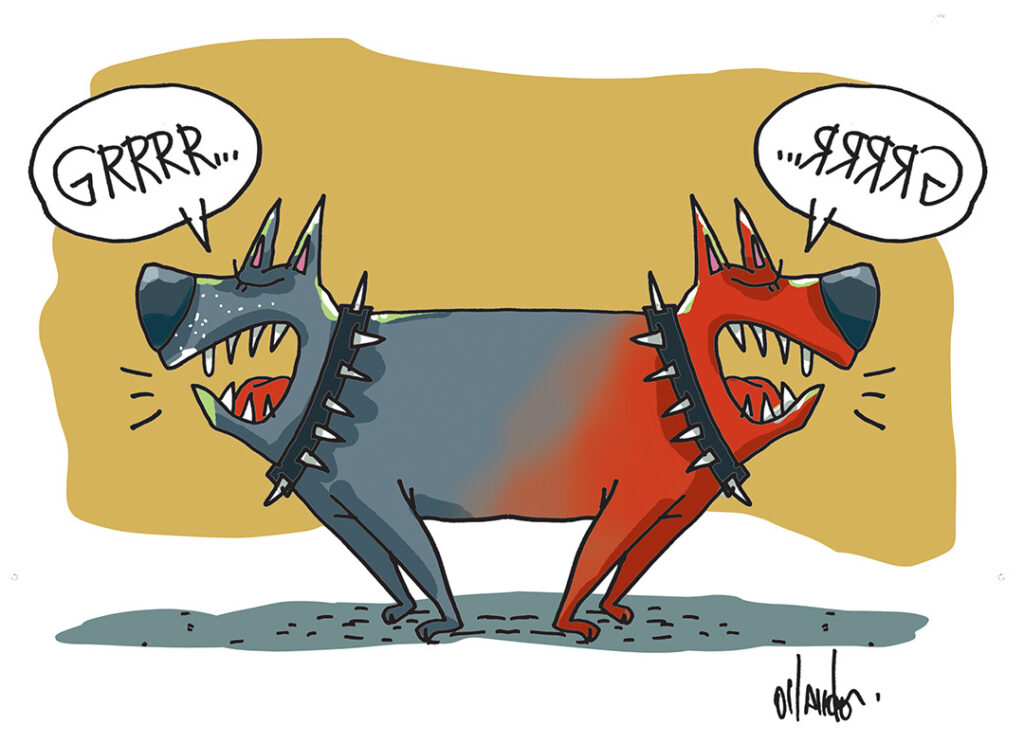
Today's world is polarized, with angry demonstrations on social media reaching a global audience, due to political positions that are divided into two sides: the left and the right. Defining a political position solely by such a generic concept is a trap full of clichés that does not reflect the complexity and contradictions of today's society. But, after all, what do these differences mean for someone to be labeled "right" or "left"?
The distinction was created at the time of the national assemblies in France, prior to the French Revolution, according to which the right wing would be against social change, linked to traditional behavior that sought to maintain the power of the French elite, and the left wing would be in favor of social change in defense of workers and the poorest population.
This conceptual duality currently makes no sense whatsoever. But the fact is that the way we position ourselves in relation to a range of issues causes us to be classified as "right-wing" or "left-wing." This ends up inducing people to lean toward a certain position, based on a classification that has been imposed on them and that will tend to influence their thoughts in other areas. It is as if people need to buy the whole package. In other words, if I am in favor of gun ownership, I have to be in favor of the death penalty, against the legalization of drugs, and against abortion. This, by stereotypical definition, makes me a right-wing political thinker. And since I am right-wing, I necessarily adhere to a liberal economic agenda. But, on the other hand, if I am left-wing, I disagree with all of the above issues and, on the economic agenda, I am a communist or an advocate of strong state intervention. Note that these precepts do not make much sense together, except under the logic of a predefined concept, which tends to induce the individual into Cartesian thinking of cause and effect and thereby influence their attitudes on other issues.
Reducing the concept to a single word trivializes understanding.
Thus, reducing a multitude of situations and conceptual positions to a single word is foolish. Journalists like to reduce an entire ideology to just one word due to a lack of journalistic objectivity (see more in the article "Objectivity in Journalism" https://www.mauricioferro.com.br/jornalismo-e-a-perda-da-objetividade/) . But along with this conceptual reductionism, the nuances that shape everyday politics are lost. How can you classify in a single word a person who defends drug use, supports gun ownership, condemns abortion, and supports same-sex marriage?
St. Thomas Aquinas discouraged King Louis IX of France (who, together with Robert de Sorbon, founded the Sorbonne University in 1257) from banning prostitution, as such a sudden interference in a millennial custom would cause more problems than solutions. Does this make Thomas Aquinas right-wing or left-wing?
Of course, the ideal is to abandon the notion of left or right and delve deeper into the merits of each issue based on its relevance in the space and time in which it is situated in society. What really matters is our commitment to intellectual honesty.
So why, even today, do we label individuals? The explanation seems to come from political propaganda strategies designed to influence large masses. Our brains crave predefined classifications that allow us to easily identify who we consider allies and who are our adversaries, and this, when convenient, is used to move crowds, as it makes it easier for us to define people by generic concepts.
Thus, if the sanctity of life is prioritized, one must oppose issues such as the legalization of drugs, abortion, the death penalty, genetically modified organisms, and euthanasia. However, if individual autonomy is defended, then naturally the existence of such actions would be approved.
Political scientists strongly criticize the terms left and right, claiming that they have lost their meaning in the modern world. For Italian political scientist Giovanni Sartori, in his book Parties and Party Systems, these terms are empty boxes, whose contents can be unloaded over time. Italian thinker Norberto Bobbio, in his book Right and Left: Reasons and Meanings of a Political Distinction, states that after the dissolution of the Soviet Union (1991), lines emerged that pointed to the end of the right-left dichotomy and the loss of influence of this polarity. Bobbio makes us reflect by asking: “Do right and left still exist? And if they still exist and are in play, can we say that they have completely lost their meaning? And if they still have meaning, what is it?”
The term right-left, however, has not disappeared; it continues to be used as a political marker and has gained complexity and greater scope. There is now talk of right-left radicals and ultra-right-left radicals. But today its meaning is irrelevant in terms of the conceptual aspect of political thought.
Nevertheless, it continues to be used as a tool to foster greater divergence in a society connected by soulless electronic devices, which support polarized expressions of hatred. These people end up being easily manipulated by generic concepts that place them in a field where there is only the clumsy duality of allies and enemies.
More about
Politics


