



Over the past week, Brazil has witnessed the eruption of a crisis that had been brewing for years and that has exposed one of the deepest rifts within the Brazilian judiciary. The open confrontation between Alexandre de Moraes and André Mendonça—the subject of our previous article—was merely the most visible episode in a much longer process.
But why has this crisis become so dramatic in a country already accustomed to dealing with economic, political, and social crises of all kinds? The answer may lie less in the individuals involved and more in what this episode reveals about the role the Supreme Court has come to play in the country.
The Last Guardian
The crisis in the judiciary is particularly serious for two reasons. The first is that the judiciary was never intended to be the venue where democracy resolves its power struggles. That role essentially belongs to the executive and legislative branches, which are the arenas designed for political debate, negotiation, and the formation of majorities.
The second point is that, under certain circumstances, members of the Supreme Court have come to perform functions that resemble those of political actors. They devise institutional solutions, participate in negotiations among the branches of government, and take a leading role in matters related to governance. Even though they retain their roles as judges, the line between their judicial function and political action has become less clear.
These two issues converge on a single point. The Supreme Court should be the ultimate guardian of the Constitution—the great social contract that underpins democracy and organizes life in society. This contract can and should be interpreted as society changes, but it cannot be bargained away as just another item in a political agreement.
To be strong, the Supreme Court does not necessarily have to be a political Supreme Court. Going against majorities is part of the very function of a constitutional court. Fundamental rights exist precisely so that certain guarantees do not depend on the circumstantial will of the majority. The problem begins when judicial intervention ceases to be exceptional and the court becomes, on a recurring basis, part of the country’s governance mechanism.
When the court charged with protecting the Constitution also becomes embroiled in the very dynamics of the power struggle, the institutional barrier that should separate the Constitution from day-to-day politics is weakened. It is this transformation—far more than any isolated incident—that makes the current crisis in the judiciary particularly serious.
From Coalition Presidentialism to Judicial Presidentialism
The root of this change goes beyond the Moraes-Mendonça crisis—or any single incident in recent years. We are talking about a structural feature of Brazilian politics.
Since the return to democracy, successive presidents have governed without a majority of their own in Congress, within a fragmented party system that requires constant negotiation to form majorities. It was in this environment that the coalition presidential system took hold. The president must build alliances with multiple parties, distributing government positions and negotiating resources and priorities to get his agenda passed.
The model survived, but the “mensalão” scandal dramatically exposed some of its costs and limitations. In the wake of that scandal—and especially following the 2013 protests and the successive political crises that ensued—the Supreme Court was increasingly called upon to adjudicate issues that had previously been resolved primarily by Congress.
Governments have turned to the courts to challenge legislative decisions, preserve public policies, or break through parliamentary gridlock. Opposition parties have done the same, but in the opposite direction. Issues that used to be resolved in Congress have increasingly ended up before the full Supreme Court—or even in individual Supreme Court rulings.
It would be simplistic, however, to attribute this expansion solely to the Supreme Court justices. The political system itself helped bring it about. The government and the opposition began to take to the courts to challenge defeats they could not reverse through political means. Congress, for its part, often left issues with high political costs unaddressed, shifting decisions to the judiciary that could have been addressed by elected representatives.
To a large extent, the Supreme Court was called upon to fill that role.
This is perhaps one of the central contradictions of Brazilian politics. Lawmakers criticize judicial activism when the Supreme Court rules against them, yet turn to that same court when they cannot secure a majority in Congress. Governments complain about judicial interference when it limits their actions, yet seek the court’s help when their agendas face legislative resistance. Judicialization has become a tool for everyone.
With each stage of this process, an additional portion of political power was transferred to the STF. Justices repeatedly called upon to adjudicate these conflicts came to occupy a position that goes beyond the abstract application of the law. Their decisions began to have direct consequences for governance.
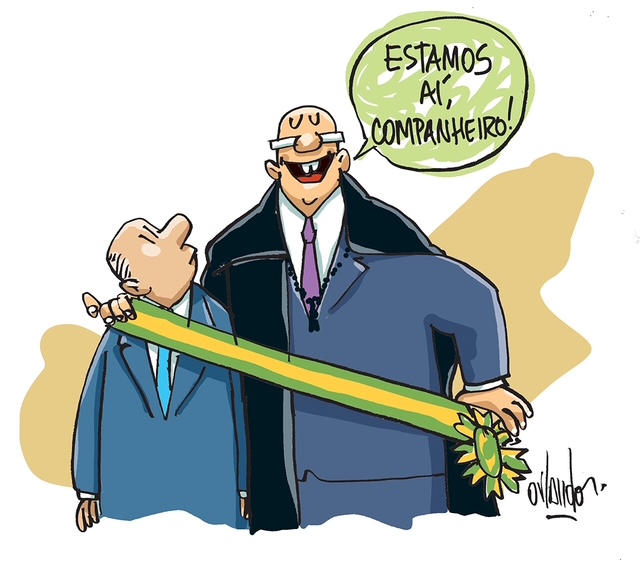
The result of this transition can be summed up in a single phrase: “presidentialism in a judge’s robe.”
While the coalition presidential system required the president to build majorities by negotiating with parties in Congress, the “robed” presidential system added a new element to the equation. Decisions critical to governance now also depended on the Supreme Court.
Without actually replacing Congress, the Supreme Federal Court has come to play an increasingly significant role in resolving conflicts that, in a healthy democracy, should be addressed through the political process.
The Risks of the Proposed Reforms
That is precisely why some proposals for judicial reform warrant caution. Proposals such as fixed terms for justices, direct elections for the Supreme Federal Court (STF), or seats reserved for certain professional groups stem from a legitimate concern about the Court’s excessive political involvement. However, they may have the opposite effect of what is intended.
Setting term limits for justices can be argued to be a mechanism for institutional renewal. Direct election, on the other hand, would turn constitutional judges into candidates. Reserving seats for specific groups or corporations would introduce a form of interest-based representation within a court whose legitimacy should stem precisely from its independence from such interests.
If the assessment is that the Supreme Court has become overly politicized, any reform should answer a simple question: Will it reduce this politicization, or will it merely give it a new institutional form?
A recent episode illustrates how politics has already infiltrated the very process of appointing justices to the Supreme Court. In April, the Senate rejected Jorge Messias’s nomination to the Supreme Court by a vote of 42 against and 34 in favor. It had been 132 years since a presidential nomination to the Supreme Court had been rejected.
Regardless of one’s opinion on the nominee, the institutional significance of this episode is clear. The selection of a Supreme Court justice has come to be viewed increasingly through the lens of the conflict between the government and the opposition. Politicization has affected both the court’s operations and the process by which it is formed.
A war without the rules of politics
It is in this context that the feud between Moraes and Mendonça is more shocking than a traditional political scandal. Professional politicians understand the transient nature of alliances and conflicts. They may harshly attack an opponent today and negotiate with him tomorrow. Democratic politics requires a certain ability to coexist with conflict.
Judges were not trained to think this way. When members of the Supreme Court become involved in a dispute of this nature, they bring into the judiciary a war whose rules belong to another branch of government.
This helps explain the intensity of the episode. More than just a legitimate legal disagreement—like so many that have historically divided courts between conservative and progressive positions—this is a dispute with institutional and political consequences that go beyond the cases currently under review and extend to the context in which the country will elect its next president.
The October election—far more than the Moraes-Mendonça crisis on its own—will determine what kind of court Brazil will have four years from now.
The first round will take place on October 4. Election polls change rapidly and, with just weeks to go before the vote, do not offer a reliable prediction of the outcome. The most important institutional factor is something else. The next president may play a role in a profound transformation of the Supreme Court’s composition.
Nor is the presidency the only variable. In October, the country will elect new senators to fill 54 of the Senate’s 81 seats. That’s two-thirds of the Senate, which must approve each nominee to the Supreme Court.
Messias’s rejection showed that such confirmation can no longer be taken for granted. The composition of the Senate that emerges from the polls could be just as important for the future of the Supreme Court as the outcome of the presidential election itself.
Four seats, a new balance of power
The scale of this change can be gauged by the number of positions at stake.
The seat vacated by Luís Roberto Barroso remains unfilled following Messias’s rejection. During the next presidential term, other vacancies may arise due to the mandatory retirement of current justices.
A significant portion of the full chamber could, therefore, change hands in just one presidential term.
The impact of these choices will extend beyond the four-year term. Relatively young justices may serve on the Supreme Court for decades. The upcoming appointments will not only define the relationship between the next president and the court; they could shape the makeup of the Supreme Court for a generation.
Perhaps this is one of the reasons why the race for the Supreme Court has become so political. A president serves a four-year term. A senator serves an eight-year term. A justice appointed to the Supreme Court can influence the country’s institutional life for decades.
The greater the perception that the Supreme Court plays a role in governance, the greater the political interest in its composition. And the greater the political interest in its composition, the greater the perception that its justices are political actors. This creates a self-reinforcing cycle.
The Problem of Legitimacy
There is also a deeper issue, related to the very legitimacy of the power exercised by the Supreme Court.
The executive and legislative branches derive their authority to exercise political power from the popular vote. The legitimacy of the judiciary, however, stems deliberately from a different source: the Constitution, independence, and the application of the law. It is precisely this difference that allows it to defy majorities when necessary.
When a court begins to perform functions that are increasingly akin to those of the political sphere, a contradiction arises. The more political the power it exercises becomes, the greater the demand for political legitimacy—a legitimacy that its very institutional nature was not designed to provide.
This is perhaps the most sensitive aspect of the “presidentialism of the robe.” The question is where the Supreme Court derives its legitimacy to exercise its power—much more so than how much power it actually has.
And there is a paradox. Seeking political legitimacy for the Supreme Court through the election of its justices or other forms of political representation would not necessarily solve the problem. It could actually make it worse. The court, which is currently perceived as merely political, would then also come to be institutionally organized according to the logic of politics.
The solution is greatness, not reform
That is precisely why this may be the worst possible time to push for a major reform of the judiciary.
Institutional reforms carried out in the heat of an election tend to reflect the interests of those who believe they will win the race. Those who believe they will control the process view the reform one way; those who fear their opponent will be in power view it another. Neither of these environments is particularly conducive to redesigning an institution that is meant to outlast both.
Perhaps the solution is both simpler and more difficult.
It demands that future presidents demonstrate greatness by appointing legal professionals—whether conservative or progressive—to the Supreme Court, rather than political operatives. Legal professionals may hold different convictions, values, and worldviews. This is natural and inevitable. What they should not bring to the court is the constant calculation of reciprocity, expediency, and governability that legitimately guides those who make their living in politics.
But the responsibility does not lie solely with the president. Congress must regain its willingness to make decisions, even when doing so carries a political cost. The government and the opposition must accept that parliamentary defeats are part of democracy and that not every defeat needs to be given a second chance in the judiciary. And the Supreme Court must recognize that its authority does not necessarily grow in proportion to its power.
The strength of an institution lies less in deciding everything than in knowing which decisions are within its purview.
If that boundary is respected once again, the court's political alignment could begin to shift without the need to change a single line of the Constitution.
Until then, Brazil will continue to live with a “presidential system in robes”—a system in which the Supreme Court serves as the ultimate interpreter of the Constitution and plays an increasingly important role in sustaining governability.
These are two enormous powers.
And perhaps the greatest institutional risk lies precisely in allowing them to continue gathering in the same place.
More about
Politics


