



“Politics should not be the art of domination, but rather the art of achieving justice.” Aristotle
Quid pro quo is a Latin expression that, in Portuguese, conveys the meaning of confusion, mistake, or a public dispute. In Anglo-Saxon countries, the meaning of the phrase has evolved distinctly, currently signifying an agreement for the exchange of favors. Thus, in its Anglo-Saxon interpretation, it would resemble the current practice of political bargaining.
Bargaining between the Legislative and Executive branches is a practice with centuries-old roots in politics. History is replete with classic cases vividly illustrating how the Executive and Legislative branches leverage their influence to appoint state ministers in exchange for political support on congressional agendas. The complex dynamic between these two branches has been growing exponentially.
For those who perceive this as a localized phenomenon, it is pertinent to recall the establishment of the Conservative Senate during the Napoleonic era. In the early 19th century, Napoleon Bonaparte emerged as a powerful political figure in France. To consolidate his dominion over the country, he sought legislative support. A notable instance occurred when Napoleon appointed members to the Conservative Senate, a pivotal institution, based on political criteria. He selected individuals who were loyal to his regime and favored his policies, thereby securing crucial legislative backing. This strategic appointment ensured the perpetuation of his authoritarian government.
The Roosevelt era and the negotiation of the Social Security Act in the U.S. during the Great Depression in the 1930s serve as another pertinent example. President Franklin D. Roosevelt faced the imperative of passing legislation to alleviate the economic crisis. To secure Congressional support, Roosevelt resorted to appointing Supreme Court justices. In a famous episode known as the "Court-packing plan," he proposed increasing the number of Supreme Court justices, citing the need to rejuvenate the court. Although this proposal was controversial, it influenced some members of Congress to support his legislative agenda, including the Social Security Act.
The most emblematic historical case involved President Abraham Lincoln and his political maneuvers to pass the law that abolished slavery in the U.S. Lincoln, the 16th president, recognized the importance of forging solid political alliances to approve the abolition amendment. Thus, he cultivated alliances with members of the Republican party, from moderate to more radical factions, and made individual pacts with Democratic congressmen, implementing a form of American “mensalão.” Following the Amendment's approval, the Speaker of Congress coined the famous phrase: “The most important law of the present day, passed through corruption, led by the purest man in the world.”
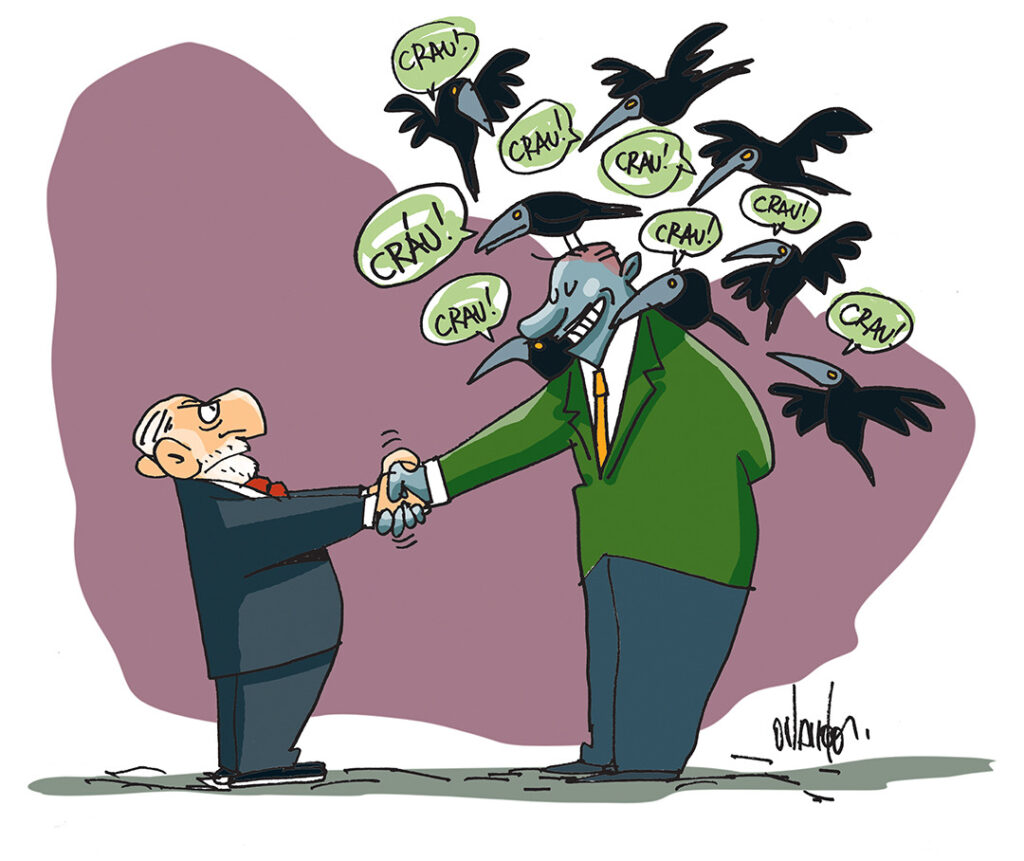
In Brazil, political bargaining is no longer conducted behind closed doors, and quid pro quo is openly conducted through the press. The stalling of important legislative agendas in the National Congress is a constant news item, pending a move by the Executive that appeases the Legislature. Congressmen, quite overtly, openly demand positions in ministries, state-owned companies, and the release of funds from the secret budget to prevent provisional measures from lapsing. The Executive, in turn, when interested in a particular legislative act, promptly offers concessions for a mere legislative approval.
As everything in life is evolutionary, what will be the boundary for this bartering policy?
The answer remains an enigma, but given the current trajectory, with retail negotiations among the Branches of Government, it will be exceedingly difficult to formulate substantive public policies. Economist Marcos Mendes, in an article for Folha de S. Paulo, aptly described how Brazil's suboptimal public policies originate. According to the economist, “there is a hyperactivity among politicians to demonstrate service, gain electoral points, and defer costs. Decisions are made, across the three Branches, in a fragmented, conflicting manner, lacking technical basis, with a short-term focus and without concern for collateral effects.”
It is natural for congressmen to seek to maximize their electoral political capital, but it falls to the Executive to forge a political alliance that prioritizes wholesale engagement, forming a minimal base for the approval of significant measures. Congress has already realized that negotiating on an ad hoc basis is proving more productive, given a fragmented and multiparty political base. In such a situation, the Executive and Legislative branches seek to satisfy their interests and preserve their political status, potentially to the detriment of citizens' interests.
The current government sought coalition with various political parties during the initial formation of its cabinet, in exchange for support in Congressional votes, thereby creating a complex web of political alliances. The strategy proved unsuccessful; the president was compelled to sacrifice allies in pursuit of coalition reinforcement, and negotiations remain contingent on specific concessions.
Political bargaining between the legislative and executive branches is a historical phenomenon that transcends borders and eras. This practice can be an effective strategy for political leaders to achieve their objectives. However, this dynamic also raises questions regarding transparency and accountability, highlighting the importance of establishing a healthy and balanced political system, through which the public interest must be preserved.
More about
Politics


The Power of Those Who Lose

The Debate Nobody Wanted
Supreme Court Without a Chief Justice


