



The most-watched tournament on the planet kicks off amid empty stadiums, closed borders, and broken promises. But no other World Cup has revealed so much about the world we live in.
The World Cup is, above all, a mirror. It does not reflect what we would like to see, but who we are. Every four years, it holds up a mirror to the world, revealing all its greatness and all its fractures. And the mirror of this 2026 edition, hosted by the United States, Mexico, and Canada, does not reflect a comfortable image.
Last week, we examined here the unique power of this tournament: its ability to forge a sense of community where the modern world breeds isolation, to suspend for ninety minutes the excessive individualism that defines our era. But soccer, as Nelson Rodrigues taught us, has always been about what happens beyond the four lines. And what happens outside those lines, in this edition, is revealing enough to warrant a second look.
Stadiums with empty stands, protests in the streets of Mexico, border controls that put referees and delegations at risk, and an expanded format that has divided experts between the euphoria of inclusion and concerns about the quality of the competition. The 2026 World Cup arrived fraught with contradictions. But perhaps that is precisely why it has never been more faithful to the historic moment we are living through. It did not create these tensions. It merely reflects them.
Stadiums Filled with Silence
The warning came early. At the match between South Korea and the Czech Republic, held at Akron Stadium in Guadalajara, entire rows remained empty throughout the night. FIFA reported an attendance of 44,985 spectators in a stadium with a capacity of 46,000. The numbers don’t lie, but they don’t explain the picture either: a stadium that was nearly full on paper, but visibly empty to the eye.
The reason is well known. According to the fan organization Football Supporters Europe, ticket prices for this World Cup are up to five times higher than those for the 2022 tournament in Qatar. For the opening match at the Azteca, fans reported paying $3,000 or more for a ticket. The final, at MetLife Stadium, costs between 3,600 and 7,400 euros. In the face of criticism, FIFA announced a $60 ticket category for all matches. A concession that points in the right direction, but one that is still far from resolving the central contradiction: the most popular sport on the planet, the one born on dirt-track streets and in the world’s slums, has driven from the stands the very people who invented it.
The model needs to be rethought. Live broadcasts ensure that billions can follow every play from wherever they are. But the stands hold a value that the screen cannot replace: they are the place where soccer becomes a collective experience in a visceral way. The World Cup excludes people from the stadiums but includes them through the broadcast. It divides people by their financial means, but still brings them together through their cheers. For now, this balance is tilted too far in one direction.
The Border and the Bouquet of Flowers
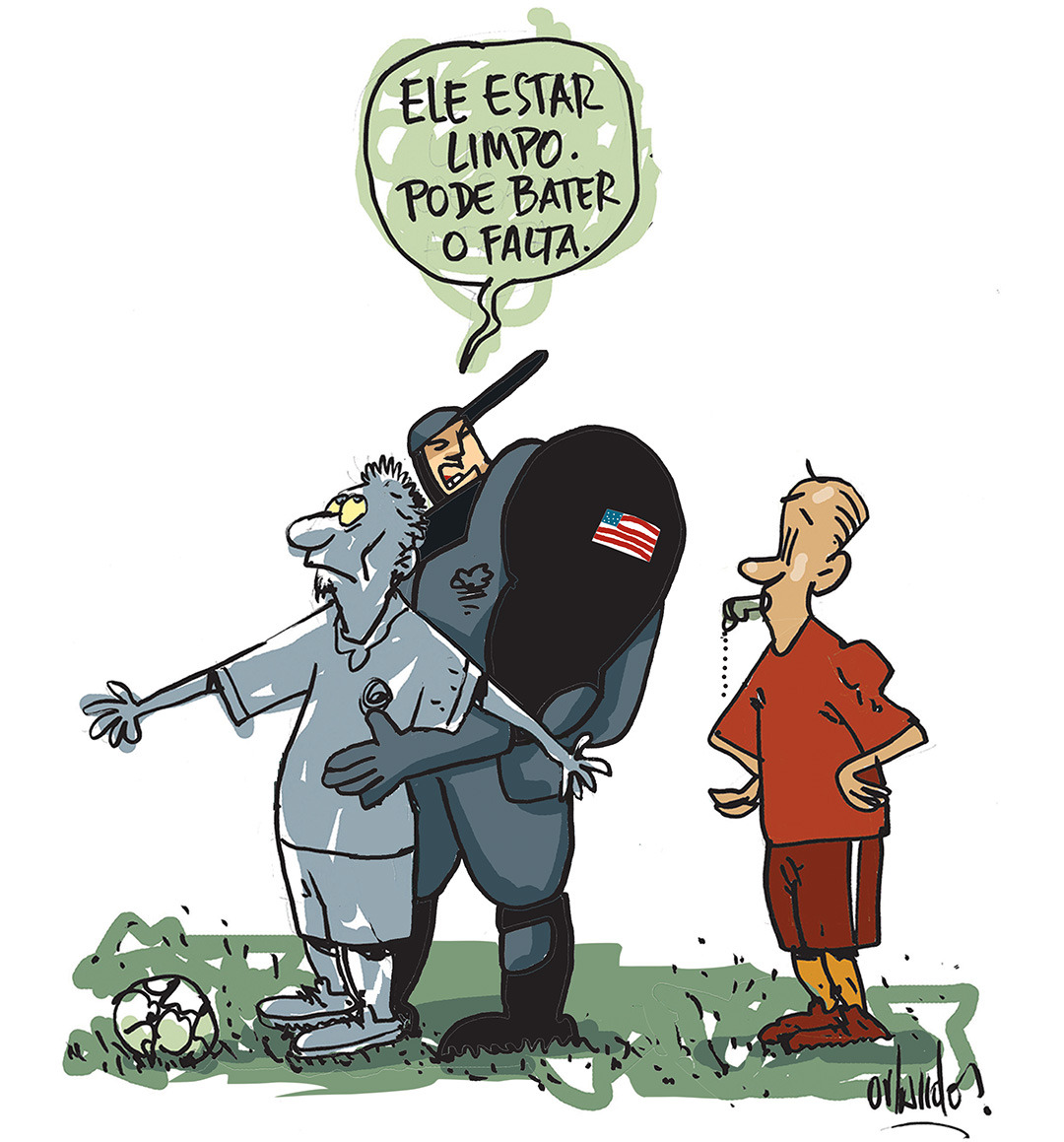
Even before the ball started rolling, U.S. entry controls had already made international headlines. Omar Abdulkadir Artan, a Somali referee considered one of the best on his continent, was barred from entering the country and will not be able to referee any matches in the tournament. Aymen Hussein, an Iraqi player, was detained for seven hours for questioning upon arrival. The Iranian national team faced restrictions on its movements during matches played on U.S. soil.
Here, however, a counterpoint is needed that the public debate has avoided. Since the attacks of 2001, the United States has systematically tightened its border controls, and this tightening is not a whim of this or that administration: it is a structural response from a country that perceives itself to be in a permanent state of threat. The relevant question is not whether a country has the right to protect its borders during an event that will host tens of millions of visitors. It does, and it would be naive to deny that. The question that deserves scrutiny is another: are the controls being applied uniformly, or selectively? Protection is legitimate. Using the World Cup as a stage to retaliate against countries with which one is in diplomatic conflict is something entirely different.
This is where history offers a powerful counterpoint. In 1998, during the World Cup in France, Iran and the United States faced off on the field at a time of acute diplomatic tension between the two countries. Before the opening whistle, the Iranian players entered the field carrying bouquets of white flowers and handed them, one by one, to each American player. It was a gesture that no diplomatic summit had been able to achieve. Soccer accomplished in ninety minutes what governments had failed to do in years.
This episode doesn’t resolve the tensions of 2026. But it reminds us of what this tournament is capable of when it’s at its best. The ball doesn’t respect borders. And perhaps that’s exactly why it bothers those who govern with walls so much.
For that very reason, it would be extraordinary if the draw for this World Cup were to place the United States and Iran in the same group. The spirit of the World Cup is, at its core, one of unity among peoples that politics insists on dividing. A match between the two teams, at this moment, would bring the world to a standstill. Not because of the players’ talent on the field, but because of the question the game itself would answer before billions of people: is it possible to come together when everything seems impossible? In 1998, the answer came in a bouquet of flowers. In 2026, it could come in a simple handshake in the center of the field. Sometimes, ninety minutes of soccer say what years of diplomacy have failed to articulate.
Mexico: Between Celebration and Protest
The opening ceremony at Azteca Stadium was, in its own way, perfect. A historic arena, hosting its third World Cup, in a country that lives and breathes soccer. But just a few kilometers from the stadium, teachers from all over Mexico marched toward the fences, protesting for better wages and against a pension reform. Residents of the Santa Úrsula neighborhood, where the Azteca is located, claimed that World Cup construction had compromised the region’s water supply.
The World Cup promised development and a legacy. What some of the communities around the Azteca Stadium got was real estate speculation and tickets that cost more than a month’s salary for most Mexicans. The tournament came to Mexico. Mexico, in significant ways, was left out. It is the mirror again, relentless: the same World Cup that celebrates the nation ignores a large part of it.
48 National Teams: A Sacrifice Worth Making
There is a structural decision that will leave a lasting mark on this World Cup, and one about which the debate has so far been more emotional than analytical: the expansion to 48 teams and 104 matches.
The criticism of the tournament is valid. Unbalanced groups, matches lacking competitive tension in the early rounds, and the possibility that fixed draws could be enough to advance. For part of the world, especially Europe, the ideal World Cup would be smaller, more intense, and more competitive from the start. This view has sporting merit. But it also carries a certain continental arrogance: the notion that top-level soccer belongs to an exclusive club of nations, and that the World Cup should reflect that hierarchy.
This expansion has a dimension that European critics tend to overlook. When a player from Somalia steps onto the field and faces Haaland, when a national team that has never played in a World Cup takes on Cristiano Ronaldo or Mbappé, something happens that no other international institution is capable of producing. The UN debates resolutions. The WTO negotiates tariffs. The World Cup puts bodies on the field, side by side, under the same rules, in front of billions of people. No multilateral body can deliver this level of visibility and mutual humanization anymore.
The sacrifice in quality during the early rounds is real. But the symbolic significance of what that match represents—something other institutions simply can no longer provide—may be worth the cost. FIFA, it seems, is not content: behind the scenes, it is already discussing an expansion to as many as 66 teams for the 2030 World Cup. There is politics behind this decision, as there is in any decision made by an entity governed by votes from smaller federations. But the humanitarian impact of gaining access to the biggest stage in world sports is, in itself, an argument that deserves to be taken seriously.
The Real Challenge: Where the World Cup Takes Place
While the debate over the number of teams is complex, there is an even more fundamental issue that the 2026 World Cup brings to the fore—and one on which public debate remains surprisingly muted: the choice of where the tournament will be held.
The United States in this edition has a virtue that is rarely acknowledged: the infrastructure was already in place. The stadiums were retrofitted, the fields renovated, and the transportation system adjusted. There will be no legacy of white elephants—those billion-dollar structures artificially erected in countries with no tradition of the sport, which after the World Cup rot away unused. Qatar built a country to host a World Cup. The human cost of this project is documented in the thousands of migrant workers—mostly from Nepal, India, and Bangladesh—who died or were subjected to conditions akin to slavery on construction sites. No beautiful goal will erase that legacy.
The 2030 World Cup, co-hosted by Portugal, Spain, and Morocco, seems like a sensible choice: existing infrastructure, a stable political environment, and no signs of conflict that could threaten the tournament’s staging. The 2034 World Cup, in Saudi Arabia, raises questions the world has yet to answer. A single country, in a Middle East still at war, with Gaza, Lebanon, and Iran as a constant backdrop. Eight years is a long time, but not that long. And the experience of Qatar leaves no room for easy optimism about what it means to build a World Cup from scratch in a country with no tradition of mass sports and severe restrictions on fundamental rights. The challenge is no longer whether to host the World Cup. It is choosing where.
FIFA needs to understand that the host city is not just a logistical detail. It is, in and of itself, a statement. When the choice is perceived as purely economic—as a contract between the organization and the petrodollar—the tournament loses something that no opening ceremony can restore: the credibility that it represents something beyond the market.
The Mirror That Does Not Deceive
And yet, something defies all these contradictions. Something that doesn’t fit into spreadsheets or official statements.
In Mexico City’s fan zones, where tickets were unaffordable, crowds gathered in front of the big screens to cheer on the national team. Mario Martínez, a fan from Tijuana who couldn’t afford a ticket, arrived early with his girlfriend to secure a good spot at the fan fest. In São Paulo, Rio, Lagos, Dakar, and Seoul, people who will never set foot in a World Cup stadium will bring the world to a standstill for ninety minutes during each of their national teams’ matches.
The World Cup outlives its organizers. It survives questionable host city choices, exorbitant prices, and political barriers because it belongs to no single entity. It belongs to the collective cry of those who, for a moment, stop living in isolation and choose to cheer together. As Johan Huizinga argued in Homo Ludens, play is the founding element of civilization: it is through play that human beings learn to sublimate conflict into symbolic contest.
Repression on one side, celebration on the other. Elitism on one side, accessibility on the other. Wars abroad, soccer at home. The 2026 World Cup is a true reflection of the world in 2026, with its divisions and its resilience, with its walls and its stubborn determination to keep trying to come together.
That doesn’t absolve anyone of anything. It doesn’t turn a mistake into a virtue, nor elitism into inclusion. But it reveals something essential: even in a broken mirror, it’s possible to recognize your own face. And perhaps that’s exactly why the World Cup, every four years, still matters.
More about
World


