


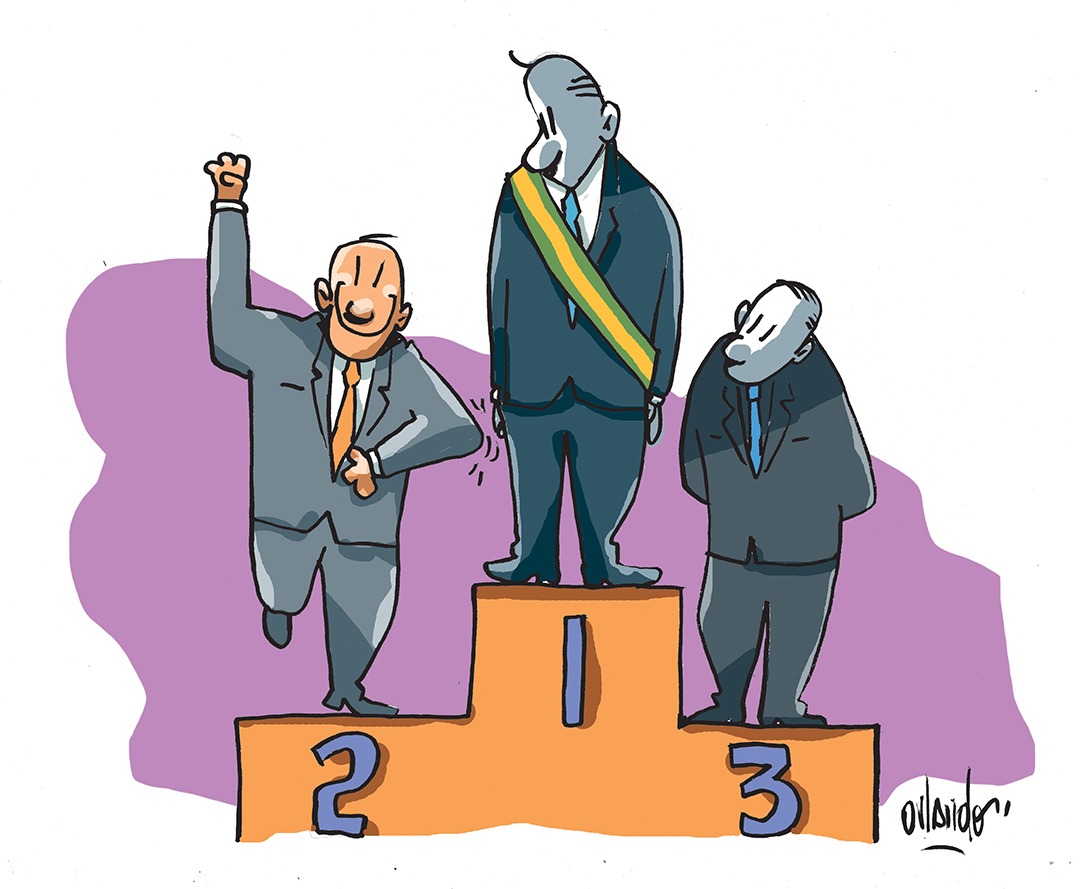
Whoever wins the October elections will be entrusted with the power to govern. Whoever loses will face an equally important opportunity: to win the trust of a deeply divided society and to influence the country’s future, even from outside the government.
Political scientist Adam Przeworski defined democracy as a system in which parties lose elections. The simplicity of this statement reveals an essential condition of a democratic system: those who are defeated must accept the results and continue to participate in political life. Losing is part of democracy. The challenge begins the very next day.
Brazil will enter 2027 marked by the political divisions of recent years. In 2022, Lula won with 50.9% of the valid votes, equivalent to 38.6% of the total electorate. Bolsonaro received approximately 37.2%. About a quarter of voters either abstained or cast blank or invalid ballots.
These figures reveal the gap between the majority needed to win an election and the support received from the electorate as a whole. More than 60% of the electorate did not vote for the winning candidate. This group includes voters who supported the opponent, those who did not vote, and those who cast invalid ballots or left their ballots blank. Their motivations vary and represent a political space that no leader can ignore.
The October 2026 polls add another factor. Lula and Flávio Bolsonaro both have disapproval ratings approaching half of the electorate. The next president will take office while millions of Brazilians reject his leadership. The loser will also have to acknowledge the significant resistance to his candidacy. The victory will determine who governs, without eliminating the political division in society.
Opportunity and Challenge for the Opposition
In this scenario, the opposition will find a unique opportunity. It will have a significant electoral base and will be able to win the trust of citizens who do not fully identify with either side. Its influence may extend beyond its parliamentary representation, supported by the quality of its proposals, the rigor of its oversight, and its ability to engage in dialogue with society.
The government will face the responsibilities of public administration. It will need to implement its agenda, manage resources, negotiate with Congress, and account for the consequences of its decisions on a daily basis. Victory grants it the legitimacy to govern and the obligation to represent all Brazilians.
Political power is not limited to control of the government or the number of votes in Congress. The ability to formulate proposals, mobilize society, and influence public decisions is also a form of power.
The responsibility to develop alternatives
The opposition has an advantage that it often squanders. Free from the pressures of day-to-day governance, it can devote greater attention to the country’s structural problems, evaluate public policies, identify shortcomings, and develop alternatives. Knowing how to make the most of this freedom may be its greatest challenge.
Recognizing the government’s correct decisions strengthens the authority of criticism. It demonstrates independence of judgment, consistency, and maturity. When the opposition criticizes indiscriminately, it becomes predictable and weakens its ability to persuade.
A Lesson from the United States
In 2000, following one of the most hotly contested presidential elections in U.S. history, Al Gore conceded victory to George W. Bush, even though he disagreed with the Supreme Court’s decision that settled the electoral dispute. In his speech, he stated that disappointment over the defeat should be overcome by love for the country and pledged to help the new president bring Americans together.
Gore had used legal means to challenge the result. By accepting the final decision, he upheld his political convictions without turning the electoral dispute into an institutional crisis.
This episode holds a lesson that is particularly relevant for Brazil in 2027.
Constructive oversight versus destructive opposition
The opposition has every right to work toward the government’s electoral defeat. The problem arises when it begins to wish for the failure of the government’s policies, even though it knows that the consequences will be borne by the people. Working to replace a leader is part of democracy. Deliberately creating obstacles to the country’s progress undermines its ability to produce results.
Driven by resentment, political conflict can deepen social divisions and encourage the formation of closed groups centered on partisan identities and particular interests. Constant outrage keeps the most loyal supporters mobilized, but alienates those who are seeking solutions to national problems.
Monitoring, reporting irregularities, demanding transparency, challenging misguided decisions, and proposing alternatives are essential functions of the opposition. It is also important to recognize that a successful public policy can benefit millions of Brazilians, regardless of who proposed it.
Education, public safety, fiscal balance, infrastructure, and productivity require commitments that extend beyond presidential terms. The opposition can contribute by setting goals, monitoring results, and advocating for the continuation of initiatives that work.
Voters will also bear responsibility in this process. The quality of the opposition should be judged by the consistency of its proposals and the seriousness of its oversight. The intensity of the attacks on the president reveals little about its ability to govern the country.
Credibility and long-term commitment
The opposition in 2027 will face a rare opportunity. It will be able to transform its significant electoral base into a force capable of influencing the country’s direction and demonstrating the competence to exercise power in the future. Its greatest asset may lie precisely among those who rejected its candidate but come to recognize the seriousness of its proposals and the responsibility with which it acts.
The credibility earned through consistent proposals, rigorous oversight, and recognition of an opponent’s successes may prove more enduring than the popularity gained through constant outrage.
The opposition must be rigorous in its principles, uncompromising in its transparency, and magnanimous in overcoming hatred.
Brazil cannot lose along with the defeated team.
More about
Politics


The Power of Those Who Lose

The Debate Nobody Wanted
Supreme Court Without a Chief Justice


