


The cancellation of the last presidential debate before the first round exposes a campaign that has traded persuasion for mobilization. The candidates, the courts, and the broadcaster itself all contributed to the same outcome: undecided voters were left without a platform.
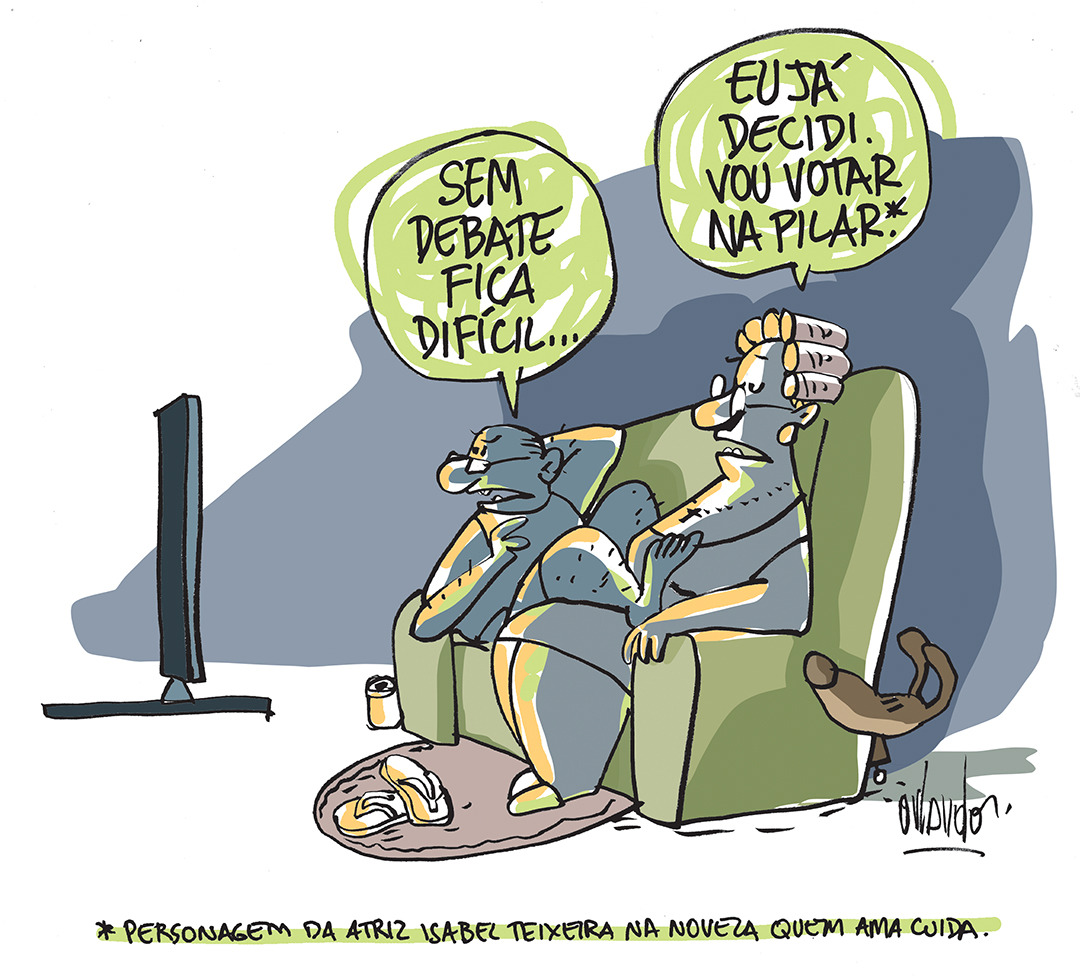
On the evening of October 1, three days before the first round of voting, TV Globo aired a soap opera during the time slot reserved for the final presidential debate. While the podiums in the studio remained empty, Lula was giving an interview on a podcast and Flávio Bolsonaro was livestreaming on social media, each facing an audience that, for the most part, had already chosen him.
Since 2002, the network had held this debate during every presidential election. That streak was broken by a combination of factors unprecedented in Brazilian electoral history. The two frontrunners in the polls refused to participate, last-minute court rulings changed the program’s rules, and Globo itself chose to cancel the broadcast.
Debates have been scaled back or canceled before, always for a single reason. The 2026 debate brings together several of these reasons at once and reveals a shift in the way campaigns are run in Brazil—and for the worse.
The campaign that gave up on convincing people
Lula and Flávio did not attend any debates in this election. Their reasons vary, but the logic is the same. The debate is the only moment in the campaign when a candidate loses control over his own message. He faces his opponent, answers questions he did not choose, and exposes himself to voters who have not yet decided how to vote. For those leading in the polls, this risk has come to seem unnecessary. Lula himself laid out this reasoning when he described the debates as fruitless and dominated by the search for “gotcha” moments, and when he said he would prefer to participate only in the runoff. The criticism of the format is well-founded. Brazilian debates have become factories for social media clips, and any candidate who attends risks handing their opponent a video that will circulate for the rest of the week.
The problem lies in what takes its place. Podcasts and live streams offer the candidate a predictable environment, a familiar interviewer, and an audience made up largely of people who already agree with him. The campaign begins to function as grassroots management, focused on mobilizing, maintaining, and reinforcing support that has already been secured. Convincing the undecided—the original purpose of public debate—has been dropped from the strategy.
Political scientist Bernard Manin described the shift from party-based democracy to what he called “audience-based democracy,” in which the relationship between candidate and voter is mediated by the mass media, and politicians address a broad and fluctuating electorate. Television was the stage for this form of representation, and the debate, its most visible ritual. The 2026 election reveals the fragmentation of this stage into thousands of segmented audiences. Cass Sunstein warned, in his studies on the internet and democracy, that personalized information environments tend to produce echo chambers, in which groups hear only amplified versions of their own convictions. This year’s campaign has adopted this logic as a strategy. Each candidate speaks to their own bubble, and the swing voter hears only the noise from both.
Robert Dahl included among the conditions for a democracy what he called “enlightened understanding”—the real opportunity for citizens to learn about the competing alternatives and their consequences. Voters who go to the polls without having seen the two leading candidates face off even once vote with less comparative information than previous generations had, even though they are surrounded by political content.
The Preliminary Injunction as a Campaign Strategy
While television has lost its central role, the judiciary has gained prominence. In less than 72 hours, rulings by the TSE and the STF changed who would participate in the debate and how Lula’s absence could be portrayed, even overturning a rule that the PT itself had signed. Legal experts disagree on the merits of each of these rulings.
The key factor in this analysis is the pattern. Campaigns have come to treat the courts as a tool for political contention just as important as the campaign trail. Lula’s coalition turned to the courts to control how his absence would be portrayed, smaller parties filed lawsuits to secure their spots, and Flávio used the court rulings as justification for withdrawing. Among the candidates who were left without a platform, a complaint spread that, in this election, the courts decide more than the voters do. The complaint is hyperbolic, but it describes a growing perception. In “Presidentialism in Robes” and “The Ruler and the Reporting Judge, ” this column has already pointed out the cost of a judiciary that becomes an arena for political disputes. The Globo episode brought this cost into sharp focus for millions of viewers. Unilateral decisions—contradictory to one another and made on the eve of the program—determined who would take the stage before voters could decide whom they wanted to hear.
Steven Levitsky and Daniel Ziblatt show that democracies are sustained less by written laws than by norms of restraint—the willingness of actors not to push their prerogatives to the limit. In Brazil, participating in debates has always been a norm of civic conduct, without any legal provision requiring candidates to do so. Recourse to the courts is also a right of every campaign. When everyone exercises their rights without restraint, the cumulative result is the erosion of the very institution that depended on that restraint.
The broadcaster that confirmed the theory
Globo cited legal uncertainty as the reason for the cancellation, while industry groups called it an attack on press freedom. The criticism is well-founded, and the network was right to denounce the rule changes just a few hours before the broadcast.
The decision to cancel deserves the same scrutiny as the decisions that led to it. There were candidates willing to debate. Globo could have aired the program with the candidates present, reported the absences within the limits imposed by the preliminary injunction, and aired its protest on the air. Instead, it chose to replace the debate with a soap opera. In doing so, it signaled to voters that a debate without the two frontrunners does not warrant prime-time airtime—exactly the premise on which Lula and Flávio based their strategies for not attending. By canceling the event, the network proved right those who preferred the podcast and reinforced the idea that social media is more valuable than television.
The impact extends beyond this election. The 2026 candidates have learned that a no-show, combined with a well-timed injunction, can derail the main debate on broadcast television without any apparent electoral cost.
The Voter Who Was Left Without a Platform
None of the players in this story acted beyond their authority. Lula and Flávio could have chosen not to participate. The parties could have appealed. The ministers could have made a decision. Globo could have canceled the event. The sum of these legitimate choices produced a result that none of them admits to having sought: the 2026 presidential campaign is heading into the first round without a single head-to-head debate between the two candidates with a real chance of winning.
Television has lost its power, and social media and injunctions have taken its place. This shift has lasting consequences. A candidate who speaks only to those who already support him wins without having to persuade anyone and governs without having been tested by debate. The court that determines the format of the debate occupies a place that should belong to the voter. The broadcaster that walks off the stage in protest confirms that the stage has lost its importance.
Brazilian democracy has weathered elections without debates before. But it had never before experienced one in which everyone involved seemed to agree—each for their own reasons—that the debate could be skipped. A campaign without confrontation leads to voters who lack a basis for comparison, and voters who lack a basis for comparison vote more out of loyalty than out of conviction.
More about
Politics


The Power of Those Who Lose

The Debate Nobody Wanted
Supreme Court Without a Chief Justice


