



"Everything I know with any certainty about morality and human obligations, I owe to soccer." Albert Camus
Albert Camus was a goalkeeper before he became a philosopher. In that solitary position, between the goalposts, he learned that life demands courage in the face of absurdity, solidarity with teammates, and individual responsibility toward the collective. It is no coincidence. The soccer field is a condensed metaphor for existence: there are rules we did not choose, opponents we cannot control, injustices we must overcome, and, above all, the need to act even when defeat is likely.
Nelson Rodrigues, who saw soccer as the raw material of the Brazilian soul, coined the definitive phrase: “The national team is the homeland in soccer cleats.” This is no hyperbole. When eleven players take the field wearing their country’s colors, they carry with them something that no politician, no economist, and no intellectual can mobilize on their own: the pure sense of belonging. Rodrigues also warned us that “in soccer, the blindest person is the one who only sees the ball,” because the game has always been about what happens beyond the four lines.
In the age of digital individualism, algorithmic bubbles, and financial globalization, the very idea of a “nation” seems anachronistic. We live in a fragmented world. And history teaches us that few phenomena still manage to unite entire populations around a common cause with as much intensity as wars and World Cups.
The crucial difference is that, unlike those rare moments of mobilization, the World Cup achieves this without deliberate destruction, without grief as its foundation, and without a death toll. If war forges a sense of belonging through trauma, the tournament does so through ritual: it channels part of the human tribal instinct into symbolic competition and celebration, even if only for a few weeks.
The 2026 World Cup kicks off on June 11, featuring 48 teams, 104 matches, and a projected audience of over 5 billion viewers. And it forces us to confront a fascinating paradox: why is a soccer tournament able to restore—albeit for just five weeks—the sacred altar of national identity that the contemporary world has abandoned?
When the Game Changed History
There is a moment, repeated in every generation, when sport transcends itself and rewrites the narrative of an entire country. At the 1995 Rugby World Cup, Nelson Mandela donned the green jersey of the Springboks—until then a symbol of the apartheid regime—and transformed it into a banner of reconciliation. In that gesture, sports achieved what decades of political negotiations had failed to do: create a moment of unity in a fractured nation.
In soccer, the 1998 World Cup followed a similar narrative. The French national team, nicknamed “Black-Blanc-Beur” (Black, White, and Arab), led by Zinedine Zidane, the son of Algerian immigrants, was crowned world champion. The victory drew 1.5 million people to the Champs-Élysées, celebrating multicultural France.
It would be an exaggeration to say that soccer abolished structural prejudices there. What it did, in a more modest and perhaps more significant way, was to open a small window: for a moment, it offered an alternative vision of social cohesion. It was short-lived, it is true. But it existed, and in certain moments—however brief—it remains in the collective memory less as a solution than as a measure of what a society can also be.
The Invisible Staircase: Social Climbing Through Gramado
From this collective memory also springs a concrete promise. Eduardo Galeano wrote that “soccer is the only religion that has no atheists.” Perhaps because it is also one of the few ladders of social mobility that capitalist society has not managed to completely block.
For millions of young people born in the slums of the world, soccer represents a real chance to escape poverty. Pelé left Três Corações, Minas Gerais, the son of a failed soccer player. Maradona was born in Villa Fiorito, one of the poorest neighborhoods in Buenos Aires. Mbappé grew up in Bondy, on the outskirts of Paris. Soccer doesn’t require a degree, doesn’t demand a famous last name, and doesn’t check your parents’ bank account.
And when these athletes rise to prominence, many of them turn their visibility into a platform for social activism. Marcus Rashford has fought against child hunger in England. Megan Rapinoe has confronted gender inequality in the United States. Vinícius Júnior, a young Black man raised in São Gonçalo, on the outskirts of Rio de Janeiro, turned every instance of racism he endured on Spanish soccer fields into a public outcry, forcing federations and governments to take a stand.
There is a case that illustrates how soccer can influence a nation’s political direction. In June 2024, when Marine Le Pen’s National Rally party made gains in the French legislative elections with a xenophobic platform that called into question the presence of people of African descent on the national team, Mbappé spoke out publicly. “I am against extremism, against ideas that divide,” declared the French captain, urging young people to vote. The French people, who knew that their championship team was the very result of that diversity, rallied against the exclusionary agenda. Soccer reminded France of who it truly was.
Reclaiming Community in the Age of Isolation
But what, structurally speaking, explains this power to mobilize? Johan Huizinga, in his book *Homo Ludens* (1938), argued that play is not a byproduct of civilization, but rather its founding element. It is through play that human beings create culture, establish rules for coexistence, and learn to channel violence into symbolic competition.
From this perspective, soccer is not mere entertainment: it is the most sophisticated expression of the playful impulse that has made us civilized.
Who, outside of a World Cup, genuinely feels like part of a nation? Social media promised connection, but delivered fragmentation. The notion of a nation—that imaginary bond between strangers who share a territory, a language, and a history—has become increasingly rare in everyday life.
The World Cup works in the opposite direction of this fragmentation. More than 5 billion people watch the same event at the exact same moment, recreating a sense of simultaneity that individualized streaming has eroded. It is not about erasing differences or conflicts, but about temporarily setting aside, for a few hours, the feeling that everyone lives in their own world.
And there is one gesture that encapsulates part of that restorative power: the embrace between strangers after a goal. There are few moments in modern life when we allow ourselves to touch, hug, and cry with strangers without feeling self-conscious. Soccer does not eliminate invisible social barriers, but sometimes it loosens them enough for a shared emotion to bridge differences that, in everyday life, remain intact.
That moment does not resolve inequalities or dispel antagonisms, but it serves as a reminder that collective experience is still possible. It is in this sense—and despite all the ethical differences between them—that the World Cup and war occupy a similar sociological space: both suspend excessive individualism and forge a common will. The decisive difference is that war unites through fear and destruction, while soccer, when it functions at its best, unites through anticipation, ritual, and celebration.
The Mirror of Ailments
It would be naive, however, to view the World Cup merely as a celebration of brotherhood. Nelson Rodrigues, who loved soccer with almost religious devotion, was also aware of its dark side. He knew that passion can blind just as much as it enlightens, that the crowd is capable of both greatness and barbarity in the same breath. Soccer also divides, hurts, and kills.
In 1969, Honduras and El Salvador fought a real four-day war, resulting in thousands of deaths, which broke out in the context of the 1970 World Cup qualifiers. The so-called “Soccer War” was not caused by the sport itself, but the match served as a trigger for migration and territorial tensions that were already simmering. The soccer field, in that case, did not sublimate the violence: it ignited it.
Racism persists in European stadiums and on social media. The economic exploitation of young athletes from peripheral countries—recruited by agents who promise Europe but deliver neglect—reproduces a colonial logic that sports should have overcome long ago. The construction of stadiums for the 2022 World Cup in Qatar cost the lives of thousands of migrant workers from Nepal, India, and Bangladesh, who were subjected to inhumane conditions under 50-degree heat.
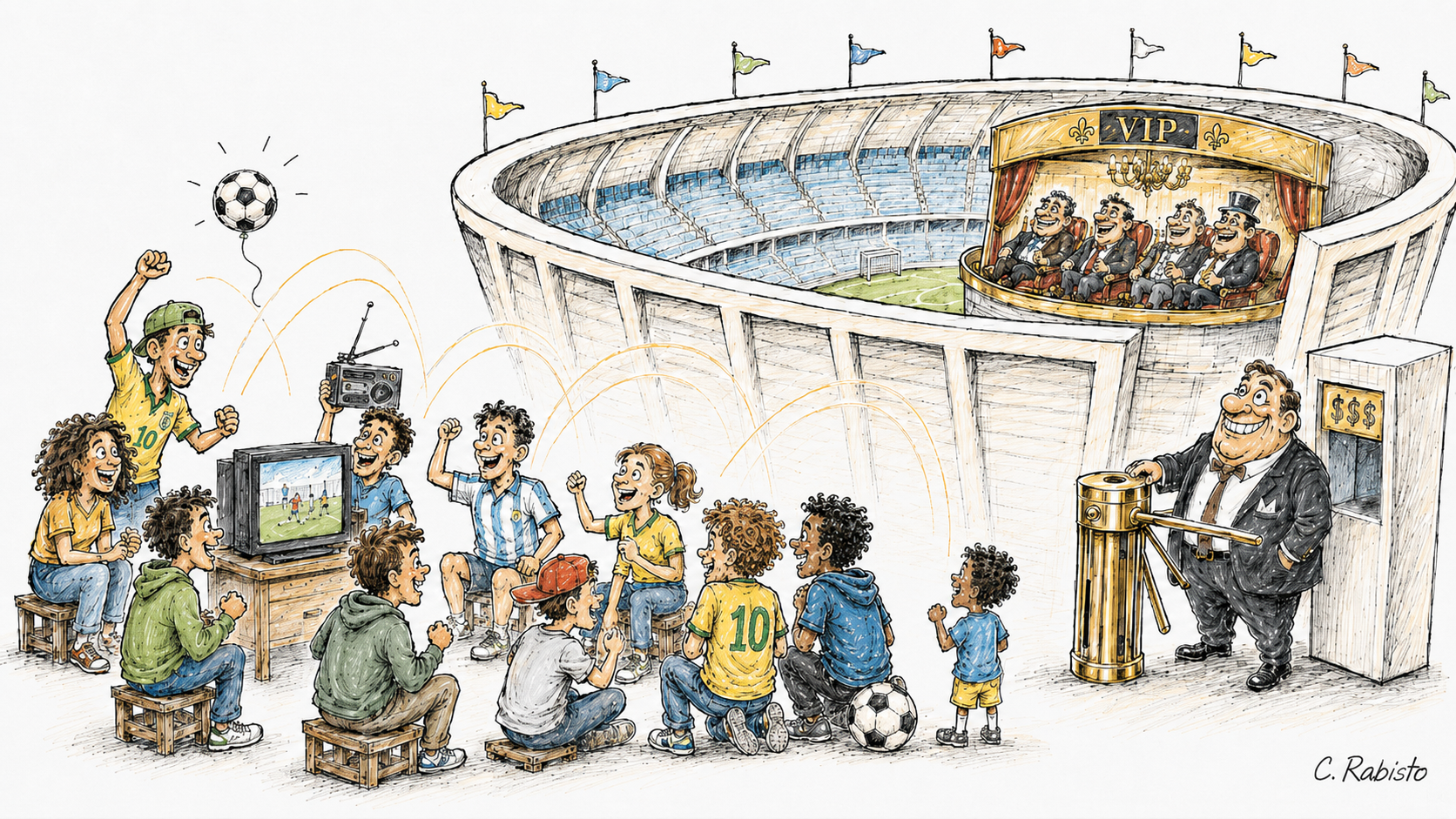
And there is a particularly painful contradiction surrounding the 2026 World Cup: ticket prices. FIFA has sold tickets for as much as $6,730 in the most expensive categories. The people who gave soccer their all, who invented the dribble on amateur fields and turned the game into an art form on dirt-covered streets, are being pushed out of the stands by market forces.
The world’s most popular sport is becoming increasingly exclusive just when it should be celebrating its universality. At the same time, anyone with a television, a cell phone, or a radio can follow every play. The World Cup excludes people from the stadiums but includes them through the broadcast; it divides people by their financial means, though it still manages to bring them together through their cheers.
The Unsolved Paradox
The 2026 World Cup presents an unsolvable paradox: while celebrating nationalism and the differences between peoples, it simultaneously fosters a rare form of global solidarity. It is through this ritualized, peaceful competition that we discover our fundamental equality. During those weeks, the rules are the same for both economic superpowers and first-time participants.
Camus was right: soccer teaches morality because it requires us to accept the absurd—the ball hitting the crossbar, the unfair penalty, the undeserved victory—and yet we keep playing. Galeano concluded: there are no atheists in this religion, for everyone, without exception, needs to believe in something greater than themselves. And Nelson Rodrigues, with his provocative style, summed it all up: the national team is the homeland in soccer cleats. It is not the homeland of politicians, nor of bankers, nor of generals. It is the homeland of the people.
To keep an eye on this World Cup is to understand that soccer accomplishes something that international politics rarely manages to achieve: creating, for a few days, a global community visible to the naked eye. This sense of community is fragile and should not be idealized.
When the final whistle blows on July 19, borders will still be standing, inequalities will continue to dictate our fates, and algorithms will once again push us back into our bubbles. Still, something remains. Not a solution, nor redemption, but a physical memory: for a few weeks, millions of strangers breathed in unison. And perhaps that is why the World Cup still matters, because, in a world that has forgotten the “we,” it gives us back, if only for ninety minutes, the sound of that word.
More about
Sports


