



The elimination at the hands of Norway has reignited the tendency to pin the blame on a single scapegoat at every World Cup. Among the pieces of this puzzle, the media is one of the most urgent areas that needs to be addressed—not least so that it can preserve its own strength and credibility.
As soon as the referee blew the whistle to end the game against Norway, the sports news had already pinpointed two prime suspects: Carlo Ancelotti, for his lineup and tactical approach, or Bruno Guimarães, for the missed penalty in the 13th minute of the first half. The elimination in the Round of 16 turned into an exercise in editorial oversimplification: find a name, close the case, move on. The 2–1 score—with two goals by Erling Haaland and a late goal by Neymar in stoppage time—hardly tells the whole story. Brazil had fourteen shots on goal against Norway—more than their opponent—and still lost. Bruno Guimarães missed the penalty kick. Endrick had a one-on-one chance with the goalkeeper and failed to convert. Neither of these two players, taken in isolation, explains an elimination brought about by an entire team that failed to turn creative control into goals.
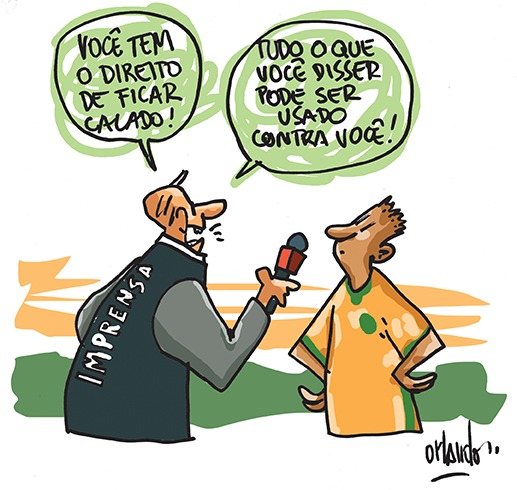
Brazil already has experience with this, and the practice is not harmless, even if it doesn’t explain everything on its own. The sports media is part of the machinery that should produce, with each elimination, an analysis commensurate with the problem, yet it shirks this responsibility whenever it chooses an easy scapegoat instead of a difficult explanation.
Carlo Ancelotti, in his postgame press conference, acknowledged that the team didn’t deserve to lose given the effort they put in on the field, but he refused to use that as an excuse and has already framed the elimination as a learning experience for the cycle leading up to 2030. This stance contrasts with the media coverage that followed, which was eager for a quick verdict and a single name to pin the blame on.
The Absence of Protagonists
A serious assessment would begin with a simple question that is rarely asked with any rigor: what talent does the national team have at its disposal today? Blaming the coach ignores this fundamental issue. The national team that lost to Norway had, among its starters, only one player capable of single-handedly deciding the outcome of a major match: Vinícius Júnior. The others, even though they play for top-tier clubs in Europe, play supporting roles within their own teams. Compare this reality to the generation of Ronaldo “Fenômeno,” Ronaldinho “Gaúcho,” and Rivaldo—players around whom their teams were tactically organized, both on the national team and at their clubs. Brazil hasn’t just lost games. It has lost star players in the strictest sense of the term—those capable of winning a match on their own.
This shortage cannot be resolved by changing the coaching staff. Ancelotti is the fourth coach to take over the national team since Tite’s departure in 2022: Ramon Menezes, Fernando Diniz, and Dorival Júnior held the position before him. Four names in four years. If turnover were the cure, Brazil would already be cured.
Ancelotti himself illustrates the problem, even though he bears no direct blame for it. Throughout the eleven games he coached before the World Cup, he repeatedly called up Casemiro, Fabinho, and Danilo—three defensive midfielders on their way out of the national team—without identifying a younger talent capable of filling the same role. Fabinho, incidentally, returned to the national team after a three-year absence precisely as an option with a profile similar to Casemiro’s. If, in eleven games, the coach failed to find a young alternative for a single position, the fault lies with the youth system that should be producing that alternative—not with the coach’s lineup choices.
This assessment, however, must take into account the extent of the losses Ancelotti himself had to deal with. In the months leading up to the World Cup, Brazil lost five starters to injuries: Rodrygo and Éder Militão, with severe ligament injuries; Estêvão, with a muscle tear; and Wesley—all of whom missed the entire tournament—as well as Neymar, who was injured in the final stretch of preparation and was sidelined for the entire group stage. What national team in the world could withstand losing five starters on the eve of a World Cup without feeling the impact?
Ancelotti also leaves behind a legacy that this elimination cannot erase. In nineteen games at the helm of the national team, including the World Cup, the coach brought out the best in Vinícius Júnior, helped Bruno Guimarães reach the highest level he has ever shown while wearing the national team jersey, cemented Matheus Cunha as an undisputed starter, and introduced two new names for the next cycle: forward Rayan and left back Douglas Santos. Heading into 2030, Brazil has more options than it did a year ago.
Against the Theory of Tactical Error
Much of the coverage of the elimination focused on Ancelotti’s lineup and tactical approach, as if a different adjustment could have changed the outcome. There is a difference, however, between a genuine tactical error and the convenient assignment of blame. In 2014, Luiz Felipe Scolari made a genuine tactical error: he underestimated Germany, failed to study the opponent with the necessary rigor, and pressed the German team as if playing at home guaranteed superiority. The result was the worst in the national team’s history. Ancelotti’s situation is different. No team in this World Cup sustained high pressure for the entire ninety minutes. The physical conditions imposed by the heat in the United States, Mexico, and Canada made the model of constant intensity—which some fans and the press are demanding, as if simply copying Jorge Jesus’s Flamengo were enough to resolve decades of structural shortcomings—unfeasible. To demand that Ancelotti adopt a style that no world soccer powerhouse has been able to sustain in this World Cup is to confuse aesthetic preference with a technical error.
The Paradox of the Foreign Coach
The media is now turning its attention to the dilemma of having a foreign coach. They’re lambasting the Italian on the grounds that Brazil needs to return to its soccer roots, which are supposedly different from the European style. Consider the paradox: the country spent years praising European soccer, its players, and, above all, its coaches. All it takes is one early stumble to reignite the absurd argument that only national teams led by Brazilian coaches can win the World Cup. How crazy is that?
The biggest problem, in fact, is the lack of star players who give the coach options, and this points to a structural issue: the Brazilian business model favors the increasingly early export of young talent, who develop in Europe in positions that do not address Brazil’s needs. When Brazil used to export players who were already mature and key players, they maintained the same positions they had here, because they were key players both there and here. Today, Brazil exports raw talent, which will be shaped according to the needs of the club that signs them, not according to the needs of the national team itself.
The Spanish and German Mirror
Brazil’s obsession with finding a single culprit hides an uncomfortable truth: slumps affect even the world’s greatest soccer powers and are not a uniquely Brazilian phenomenon. Spain, now hailed as a model of positional soccer, won the World Cup in 2010, was eliminated in the group stage in 2014, failed to advance past the round of 16 in 2018 and 2022, and reaches this Sunday’s final against Argentina after a sixteen-year drought. World Cup title, early elimination, early elimination, lackluster campaign, final. Few Brazilians would accept this script for their own national team, but they applaud when it happens to another country. Germany, a four-time champion and winner in 2014, was eliminated in the group stage in 2018 and suffered another early exit in 2022, also in the group stage. Soccer giants go through dry spells. The difference is that they rebuild with patience, while Brazil treats every elimination as a murder that demands a killer. The Spanish and German media treat these cycles as part of the game, not as a scandal to be resolved at a press conference. It is this analytical sobriety—more than any momentary technical advantage—that separates a mature soccer powerhouse from a national team held hostage by its own headlines.
The Export Model and the French Example
It’s also worth noting the French example. In this World Cup, 76 players born on French soil are playing for other national teams, thanks to dual citizenship and ties to former colonies. France’s program to attract talent from these communities has been in place for decades: one need only compare the composition of the French national team from the 1990s to the present. As a result, France has an abundance of star players for the coach to choose from, which helps explain France’s dominance in recent years, with one title and one final appearance in the last two World Cup cycles. With each World Cup, the team grows stronger.
Brazil needs to keep a close eye on its own young players and also look for talent from other countries who, after eventually becoming naturalized, could strengthen the national team. Due to the CBF’s oversight, the country has lost players such as Jorginho, Thiago Motta, Thiago Alcântara, Deco, Pepe, Otávio, and Matheus Nunes—all of whom have some connection to Brazil—to other national teams. Brazil needs to broaden its horizons.
A Tradition of Sole Culprits
The Brazilian sports press has a long-standing tradition of this kind of oversimplification, repeated with every elimination since the 2002 World Cup victory. In 1998, Ronaldo’s seizure hours before the final against France became the official explanation for a 3–0 loss, absolving a team that had already been performing inconsistently throughout the tournament. The incident went far enough to trigger a congressional investigation, launched in 2000 to examine the contract between the CBF and Nike and the suspicion that the sponsorship even influenced the national team’s lineup. In 2006, the image that stuck was that of Roberto Carlos adjusting his sock at the very moment Thierry Henry scored the goal that eliminated Brazil in the quarterfinals—a convenient excuse to explain ninety minutes of lackluster soccer against a French team that was clearly superior that night. In 2010, the own goal and Felipe Melo’s ejection during the comeback against the Netherlands became the official summary of an elimination that involved questionable decisions by coach Dunga and a squandered lead. In 2014, the 7–1 loss to Germany at Mineirão precludes any individual blame, yet it still produced parallel scapegoats: the absence of Neymar, who was injured in the previous round, and the suspension of captain Thiago Silva—both cited ad nauseam as the causes of the rout, when the real problem was Felipão’s tactical decision, as discussed above.
In 2018, against Belgium, the preferred explanation centered on the lineup: Marcelo’s substitution for Filipe Luís was treated as if that single change alone had determined the 2–1 elimination, overshadowing a second half of fruitless play against a more organized Belgian team. In 2022, Brazil lost on penalty kicks to Croatia after Rodrygo’s shot was saved by goalkeeper Livaković and Marquinhos hit the crossbar, but the criticism had already settled, even before the penalty shootout, on another play: the view that Casemiro should have committed the tactical foul that would have stopped the counterattack leading to Croatia’s equalizing goal in extra time, as if that specific moment summed up the entire 120 minutes of a team that failed to hold onto the lead opened up by Neymar. Now, in 2026, that role falls to Bruno Guimarães, even though he was far from being the only one responsible for the missed chances that afternoon.
Twenty-five years later, Congress turned its attention back to soccer, but shifted its focus. Days after the 2026 elimination, a bill introduced in the Chamber of Deputies proposed banning players and coaches based abroad from joining the Brazilian national team, on the grounds of strengthening domestic soccer. In 1998, Congress was investigating whether a multinational corporation was exerting too much influence over the team’s lineup. In 2026, Congress is proposing to address the lack of star players by legally restricting who can play for the national team. Look where we’ve ended up.
The Curtain the Press Puts Up
The pattern seen in 2026 confirms a broader trend that has spanned decades: the Brazilian sports press tends to spare the team as a whole and focus its criticism on a single individual—whether the coach or the player responsible for a specific play. The historical exception is Neymar, who has been persistently criticized throughout his entire career with the national team, even during campaigns in which his individual performance was not the central issue. Aside from this case, the rest of the squad has weathered eliminations almost entirely free from personal criticism. Against Norway, Brazil held on to the result until the 80th minute, when Haaland decided the match with two goals. It wasn’t a team that was dominated from start to finish; it was a team lacking a player capable of deciding the match on his own at the moment the game called for a decisive play. Even so, post-game coverage focused almost entirely on Bruno Guimarães’s free kick and Ancelotti’s lineup. Endrick, who squandered a clear chance one-on-one with the goalkeeper, barely made the headlines the next day. Neither did the other nine outfield players who were on the field. The truth is that the players weren’t decisive when we needed them to be.
When the coach is to blame, he bears the loss alone. When a player is to blame, he bears the loss alone. The team, almost never. A serious analysis would make this list complete: neither star players, nor the heat, nor four coaching changes—any of these factors on their own—explain the elimination. The entire process explains it, and the media is one of the few elements of that process that could change its stance without relying on investment, youth development, or the patience of the CBF.
The Media's Own Interest
The Brazilian sports media faces the same credibility crisis that journalism in general is going through: fragmented audiences, algorithms that reward instant reactions, and a public that is increasingly skeptical of traditional coverage. Insisting on the easy scapegoat generates engagement on the day of elimination but, elimination after elimination, erodes the authority of those who should serve as the fans’ analytical reference. Offering analysis rather than a verdict strengthens the soccer the press covers—and the very reason for the press’s existence—at a time when that authority can no longer be taken for granted.
A Piece of the Puzzle, Not the Whole Explanation
Brazil lost to Norway for several reasons that predate Bruno Guimarães’s missed penalty: it has fewer and fewer players capable of deciding games on their own, it insists on playing a style that no team has sustained in this World Cup, and it has gone through four coaches in four years without addressing the root cause of the problem. None of this can be blamed on a single player, nor could it all be placed on the shoulders of a coach who was hired just a few months ago. The media inherited these problems—it didn’t create them—and continues to treat every elimination as a verdict rather than an investigation. Part of the solution depends on diagnosis, which is the job of those who cover the story, not just those who play the game.
The “only the title counts” culture has turned Brazilian fans into judges who rarely scrutinize the court itself. The sports media has the power to temper this culture or to fuel it, and today it chooses to fuel it. Spain accepts that titles come in cycles; Germany rebuilds without hysteria after every setback; and this maturity has as much to do with the patience of their federations as it does with the level-headedness of their media. Brazil continues to need a scapegoat at every World Cup. Replacing the villain of the moment with a better question is a step in the right direction—perhaps the most effective one of all—because it doesn’t cost the CBF a penny. The benefit would be twofold: for the soccer the press covers and for the press itself, which needs to regain the authority of those who analyze, not just those who narrate.
More about
Sports


