



I'll say right now that I don't. Perhaps I'm alone in this opinion.
We are halfway through the season and already fans, coaches, players, and sports commentators are complaining about the Brazilian soccer calendar. They claim that the championship is the most competitive in the world due to its unpredictability (even if this is due to the low technical quality of the teams) and that the physical strain is too great due to the excessive number of matches. Indeed, if we look at the Brazilian championship since 1971, there are a myriad of champions: 17 clubs. In the Brazilian Cup, the number is similar to 16. Thus, practically all clubs in the first and second divisions of the Brazilian championship have been national champions, and we rarely have a repeat of champions in the same tournament, which causes the false impression that there is a technical balance between the teams.
This balance may have been true in the past, when all clubs were indebted and poorly managed—often due to a caricatured president. Currently, Flamengo and Palmeiras stand out from the rest in economic terms and in terms of their squads because they have been competent in their management, which is why they alternate success in the continent's main tournaments. Both are financially sound and able to sign and retain the country's and continent's top players with high salaries and present and future projects that attract elite players. But, as always, at the end of each season we always have a winner—or a few winners, if we consider the other Brazilian and continental championships. The justification for defeat is always the same: the schedule. Even when a player misses a penalty or a goal in front of the goalkeeper in the final match of a championship, or even when the goalkeeper makes a blunder, the schedule is always the biggest villain.
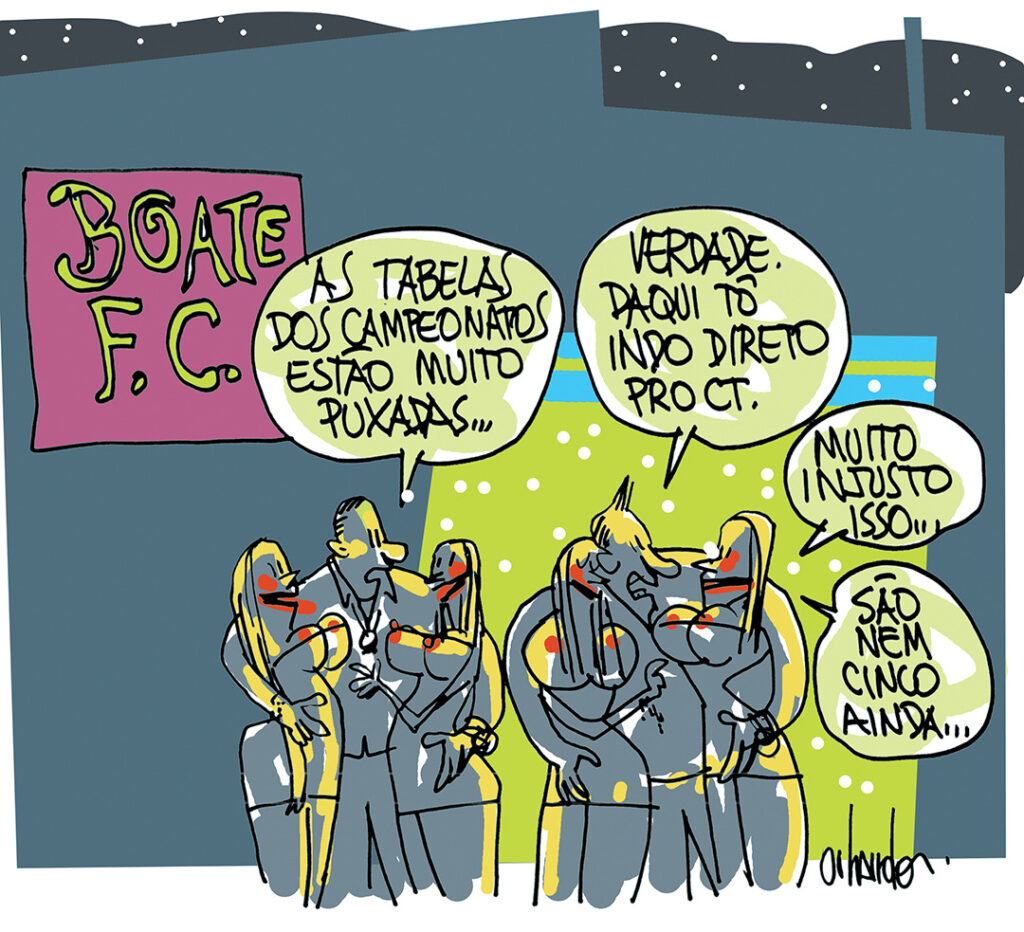
Nothing is more common and hackneyed than hearing coaches complaining about the sequence of games played by teams participating in the main competitions involving Brazilian teams.
Liverpool manager Jürgen Klopp's surprise at discovering that his opponent in the 2019 Club World Cup final had already played more than 72 games that season became a milestone in this discussion. The team in question was Flamengo, which, despite this heavy schedule, won the Brazilian and Libertadores championships and played a very tough game in the World Cup final against what was then the best team in the world, coached by Klopp. Also famous were the complaints of Abel Ferreira in 2020, when his Palmeiras team finished fourth in the same tournament, having lost the semifinal and the third-place match to Tigres of Mexico and Al Ahly of Saudi Arabia, respectively. The coach blamed fatigue as the main culprit for such poor results and distilled his already famous and heated criticism.
If a Brazilian team goes through all the competitions and reaches the final stages of each one, it will play more than 70 games in 10 or 11 months, depending on the preseason period and the players' vacations, which averages less than two games per week. Manchester City, for example, played 69 official matches in the 2022/2023 season, while Real Madrid played around 61 official matches in the same season. The fact is: in Brazil, more matches are played than in other South American and European leagues. But what does that mean? It means that there is an increasing need for well-planned scheduling. The new season starts in the previous year, even before the current one ends.
I challenge the reader with the following question: is the schedule really the main villain of Brazilian soccer? Is it the main culprit for defeats, as coaches and managers insist? Is it what causes Brazilian teams to succumb to European teams? Or is all this just a crutch for coaches and managers to justify poor planning for the season?
Not enough time to train or resources to hire? Which is worse?
I tend to disagree with those who blame the calendar. And, to that end, I invite you to consider a few reflections. First: soccer has become big business, like any other, in which large sums of money are heavily invested in exchange for sporting results and financial returns. It involves passion, it is true, behind-the-scenes disputes, and the hidden actions of the “Supernatural Almeida,” but it is still a business that requires millions to build competitive teams. In a previous article, I wrote that planning leads to victories, and like any large company, planning for the coming year and the next five years is the key to success. Teams that are more technically skilled and have well-balanced rosters stand out from the rest, but without financial stability and adequate planning, they will succumb the following year and will not become sustainably competitive teams. This is the case with Corinthians and Atlético Mineiro, which prioritized sporting competitiveness at the expense of financial stability. As a result, they live off occasional surprises. However, this surprise effect will become increasingly rare in soccer, as it already is in other sports.
It is increasingly clear that the best teams are the favorites, stand out, and grab the largest sponsorship and image rights funds. The dynamic creates a virtuous circle: the more the team wins, the larger its fan base becomes, the more sporting goods it sells, and the number of fan club members grows, generating more income for the club, in addition to television rights fees. Let's look at the following logic: Flamengo has approximately 45 million fans; if only 5% of fans sign up as fan club members, we will have 2.5 million paying members. The cheapest fan membership program costs R$ 50.00, which multiplied by 2.5 million fan members equals R$ 125 million per month, which multiplied by 12 months equals R$ 1.5 billion per year. In other words, with fan membership alone, Flamengo already achieves globally significant figures. This exponentially increases the club's investment capacity in its soccer team. Add to that the sale of match broadcasts, jerseys, tickets, and the sale of players to Europe. Here lies the main advantage of the extensive Brazilian soccer calendar.
The Brazilian soccer business model is based on the enormous capacity to train young players and sell them to European clubs. These sales currently depend on international agents who broker these million-dollar transactions, based on their relationships with European clubs. Brazilian clubs are therefore at the mercy of these agents, who choose the best business opportunities, since European clubs have finite budgets and must comply with financial fair play rules each season. Applying this example to the business world, imagine Vale, Brazil's largest iron ore exporter, needing intermediaries outside the company to meet its budget. That's not how the business world works. Vale has outsourced agents, known as traders, but they represent a much smaller share of its revenue management.
Therefore, clubs need to give young players visibility. And this visibility only happens if these young players are on the field, even if occasionally, in the main team. So, to generate cash, gain visibility for sponsors, and encourage fans to sign up for a fan membership program, a team needs to play. It must compete in as many championships as possible, qualify for international tournaments, and even, if possible, tour other countries. Does it make any sense, then, to see managers calling for fewer games? No entrepreneur would complain about having too many customers to serve. Instead, they would seek to expand their company and their sales teams in order to serve more and more customers. Why do soccer teams complain instead of restructuring themselves?
That's not the only point. Since a generous portion of club revenues still comes from the sale of players, youth teams need to be improved and developed. The young stars of the teams need to experience this highly competitive environment and face opponents of a higher level than in youth games. One of the great advantages of a well-equipped, modern training center is that it allows young players to interact with professional players, thereby facilitating their acclimatization and education. Not to mention the social aspect of clubs investing in youth teams and lifting our young people, and why not say children, out of poverty, who often leave their hometowns, leave their parents, and at a young age throw themselves into the big soccer centers to have at least two meals a day and some opportunity in life, where their talent can at least compete with other more affluent players.
If the number of games is reduced, how will these young players get the opportunity to showcase their talents? This is precisely why European teams purchase young players with little or no professional experience and then resell them at a significantly higher price. There, they gain the opportunity to play, improve, and, as a result, become more valuable. Often, we don't even know the young Brazilian who moved abroad without ever having played for a professional team in Brazil.
In this way, the calendar can help in the training of these young players. Many criticize the state championships, something that is unique to a continental country like Brazil. But why not use this tournament as a preseason? Why not use the youth teams in these competitions and save the main team for the final stages? Why, instead of complaining about the calendar, don't officials fight against clauses that force teams to play with their main squad in empty games in the qualifying stage of the state championships?
Brazil is a country that trains players. In 2022, we remained at the top of the ranking of countries that export the most, well ahead of France and Argentina, respectively second and third on the list. This should be yet another reason to encourage our leaders to seek more opportunities for their teams to play. This is the cycle that generates wealth for clubs, which can invest in youth development, infrastructure, and building stronger squads, mixing young players with more experienced athletes. That way, everyone wins.
Awareness needs to change across the entire soccer ecosystem. Grumpy coaches and post-defeat excuses at press conferences will always exist. But they cannot hide the fact that our soccer is losing competitiveness every year because our clubs are increasingly mired in debt. And lack of money is not the cause, because everything has grown lately: broadcasting rights, player sales, and even stadium attendance. But there is a lack of management to transform resources into solid progress. Just as the busy schedule is an excuse, so is the lack of money circulating. Otherwise, how can we explain the fact that the Copa Libertadores, a tournament that a few years ago was the specialty of our Latin American neighbors, has become a competition that, with the exception of one or two Argentine teams, is largely dominated by Brazilian teams? Professionalizing management is no longer a choice but a matter of survival for most national teams. It is no wonder that we have not won a World Cup in so long or that our teams have found it increasingly difficult to compete against the "powers" of the Arab world. Because this is a problem that permeates all spheres of Brazilian soccer. Certainly, our calendar can be improved, but it is by far the least of our current problems.
More about
Sports


